

What if the right choice of wrapper depends less on headline speed and more on the loads moving through your warehouse each day? A turntable stretch wrapper rotates the pallet as film is applied. Whether that format suits your operation depends on your pallet and load mix, handling methods and available floor space. The aim is to achieve consistent wrapping without creating a bottleneck or disrupting established warehouse routines.
This practical UK buyer’s guide explains the wrapping cycle and what to assess before investing. Use it to build a shortlist around load dimensions and stability, required containment, wrapping volume, operator involvement and automation needs. It also covers the machine features that affect wrapping consistency and the practicalities of fitting a wrapper into an existing production or dispatch area.
Phoenix Handling Solutions supplies rotating turntable stretch wrappers alongside rotating arm and ring wrappers. The company also provides installation, commissioning and operator training, as well as servicing, service contracts and spare parts. Considering these stages alongside the machine itself helps you plan for its introduction and ongoing use.
Key Takeaways
- A turntable stretch wrapper may suit your operation when your pallet and load patterns work with a rotating platform.
- Map the wrapping cycle from pallet positioning to unloading, noting where operator input is needed at each stage.
- Compare manual, semi-automatic and automatic operation by operator involvement, cycle control and integration requirements.
- Record typical and outlier pallet dimensions, load stability, wrapping routines and available floor space before comparing machine specifications.
- Plan for the full journey from requirements and machine supply through installation, commissioning, training and ongoing support.
What is a turntable stretch wrapper, and when does it suit pallet wrapping?
A turntable stretch wrapper secures a palletised load by rotating the pallet on a platform as stretch film is applied around it. The film helps hold items together for handling and onward movement. The machine is only one part of the process, however: pallet presentation, load shape, operator tasks and the next stage of material handling all affect whether this format fits.
A turntable is one pallet-wrapping option, not a universal solution. It is worth assessing when pallets can be positioned and rotated on a platform and the wrapping routine is reasonably consistent. If load dimensions, shapes or handling requirements vary, look closely at how pallets are brought to the wrapper and removed afterwards. The key question is whether the full working cycle suits your loads and site, not simply whether a machine is labelled a turntable model.
Work through the decision in order: understand the loads, map the wrapping process, compare the machine specification with the work, then plan installation and ongoing support. This keeps your shortlist tied to the operation rather than a collection of features considered in isolation.
How does a turntable pallet wrapper work?
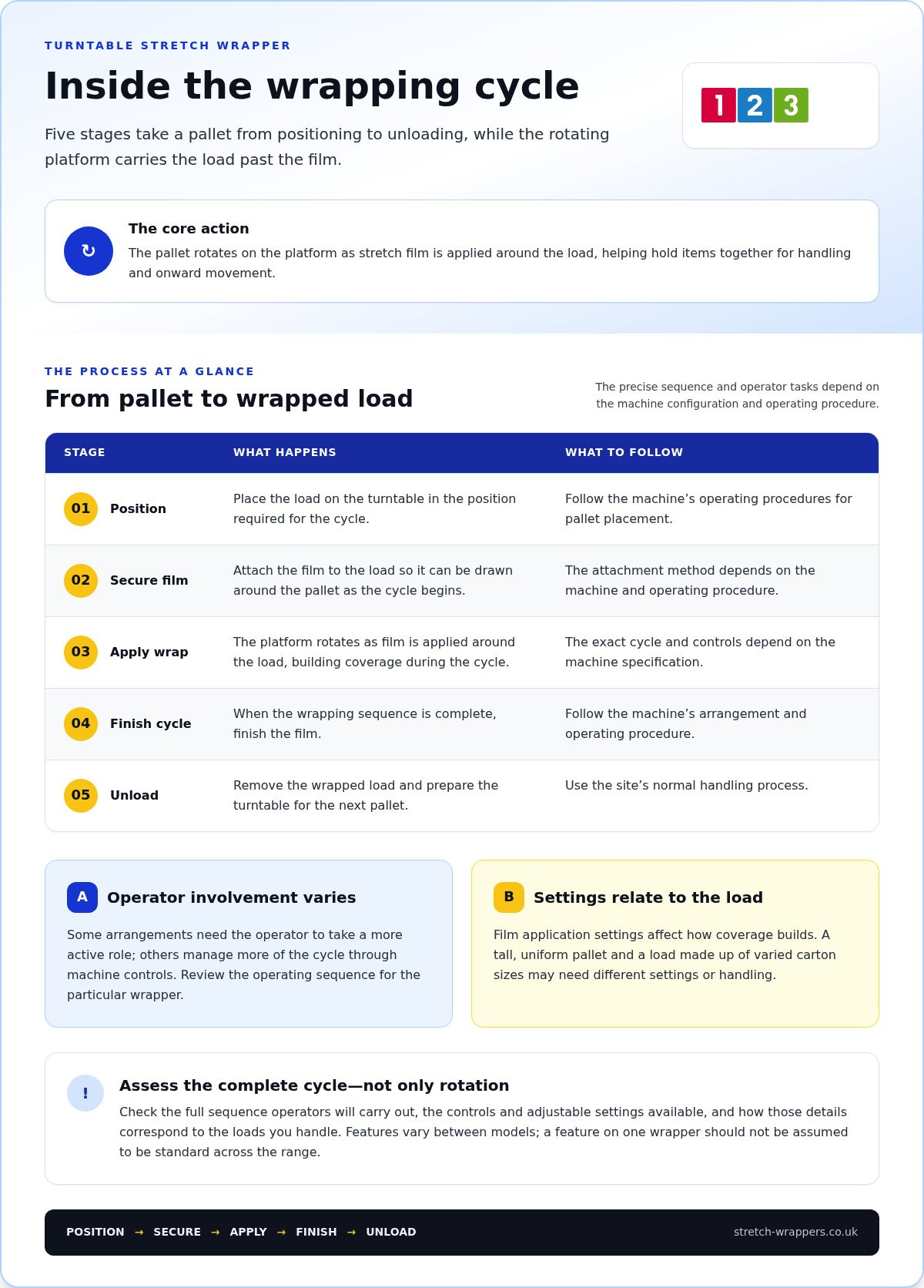
The pallet is positioned on the turntable, film is secured to the load, and the platform rotates as film is applied around it. At the end of the cycle, the film is finished and the wrapped pallet is removed. The exact sequence of operator tasks and machine actions depends on the configuration. For general background on the material itself, see Stretch wrap.
Operator involvement, controls and cycle functions vary between models. Some arrangements require the operator to take a more active role; others manage more of the cycle through the machine. Check the specification and operating sequence for the particular wrapper rather than assuming that a feature on one model is standard across the range.
What kinds of operation should assess a turntable wrapper?
Start with your pallet format, the range of loads you wrap and the routine used to move pallets through the wrapping point. A steady flow of similar pallets presents different requirements from a process where load shape, stability or handling changes from job to job. In either case, include what happens before and after wrapping in your assessment.
For a repeatable routine, consider whether pallets can be presented consistently and whether the operator’s role suits the pace of work. If loads vary or handling needs differ, include those variations rather than treating one example pallet as representative of every job. The right format depends on the whole operation: load mix, working space, handling arrangements and the level of operator involvement required.
Inside the turntable wrapping cycle: film application and load containment
Load containment means keeping the items on a pallet suitably secured together for handling and onward movement. The wrapping cycle applies film around the load to help achieve that, and the result depends on how the film is applied and how the load is presented. In simple terms: the pallet’s rotation carries the load past the film, building coverage around it as the wrapping cycle runs.
What happens during a typical wrapping cycle?
The broad sequence is straightforward, although operator tasks and machine controls vary with the wrapper’s configuration:
- Position the pallet. Place the load on the turntable in the position required for the cycle, following the machine’s operating procedures.
- Secure the film. Attach the film to the load so it can be drawn around the pallet as the cycle begins. The method depends on the machine and operating procedure.
- Apply the wrap. The platform rotates as film is applied around the load. The precise cycle and controls depend on the machine specification.
- Finish the cycle. When the wrapping sequence is complete, finish the film as directed by the machine’s arrangement and operating procedure.
- Unload the pallet. Remove the wrapped load and prepare the turntable for the next pallet, following the site’s normal handling process.
This is a general outline, not a claim that every machine follows identical steps. Some tasks involve more operator input, while others are managed through the machine’s controls. When assessing a turntable stretch wrapper, review the full sequence your operators will carry out, not just the time the pallet spends rotating.
Why do film tension and wrap settings matter?
Film application settings affect how film is drawn around the pallet and how coverage builds across the load. The aim is to wrap each load appropriately for its handling needs. A tall, uniform pallet and one made up of varied carton sizes may need different settings or handling. When comparing machines, check which settings can be adjusted and how they correspond to the loads you handle.
Pre-stretch is another feature to compare where available. It means stretching the film through the machine before applying it. Its presence alone does not show whether a configuration suits your loads or wrapping routine, so assess it alongside the available controls, operator tasks and containment requirements.
For context, Schott Packaging describes features on one of its own semi-automatic models, including selectable wrap programmes and film cut-off. These are examples specific to that competitor’s model, not features to assume are standard across the category or part of Phoenix Handling Solutions’ offering. Compare machines by the functions they actually provide to set realistic expectations.
To compare equipment against your operation, explore stretch wrapper options as part of building a practical shortlist.
Compare turntable wrapper configurations and features that affect machine fit
Once a turntable appears workable for your loads, compare how much of the wrapping cycle the operator will manage and what the machine needs to connect with elsewhere in the operation. Manual, semi-automatic and automatic describe broad levels of involvement, not fixed specifications. Controls, film application features and integration arrangements differ between machines.
How do manual, semi-automatic and automatic options differ?
The table is a starting point. Treat each description as a general category, then compare it with the actual machine specification and your day-to-day process.
| Operation | Operator involvement | Cycle control and film application | Integration considerations |
|---|---|---|---|
| Manual | The operator has a hands-on role in applying film and managing the wrapping task. | Film application and cycle steps involve direct operator input; the exact arrangement depends on the equipment. | Consider how pallets are presented, moved and wrapped within the existing routine. |
| Semi-automatic | The operator prepares the load and takes part in starting, attending to or finishing the cycle, depending on the model. | Some cycle functions are controlled by the machine; the available settings and film features are specification-dependent. | Assess operator access, pallet movement and how the machine fits the wrapping point. |
| Automatic | The machine manages more of the wrapping sequence, while the operator’s remaining tasks depend on the configuration. | Cycle control and film application functions are model-specific and should be assessed against load requirements. | Review how the wrapper will fit into the wider material-handling process and any required line connections. |
More automation is not automatically better. If pallet presentation varies or the operator manages several tasks around the wrapping point, a different configuration may fit the workflow better than a higher level of automation. Compare the operator’s actual role, cycle control and site integration needs before deciding.
Which machine details should buyers compare?
Build your comparison around your pallets and site, not a specification taken from another model. Record the dimensions and weight range of your loads, including unusual examples, then check each machine’s stated limits and assess:
- Load and turntable fit: pallet dimensions, load profile and the machine’s specified capacity.
- Access and handling: how pallets reach and leave the turntable, including the access arrangement required by your handling equipment.
- Controls and film application: available cycle settings, operator tasks and film features relevant to your loads.
- Site requirements: power supply, physical footprint, access for installation and integration with surrounding equipment.
Check each point against the specification for the particular model. A competitor’s stated speed, dimensions or power supply describe that model only; they are not a general turntable standard or a Phoenix machine specification. Phoenix Handling Solutions supplies turntable, rotating arm and ring stretch wrappers. If the way a load is presented makes the wrapper format a key question, compare these alternatives against your handling process rather than assuming one format suits every operation.
How to assess whether a turntable stretch wrapper fits your operation
A useful machine brief starts with the work as it happens on site, including the pallets you wrap most often and less common loads that can challenge a standard routine. Record typical and outlier loads before comparing specifications, then map how each pallet gets to the wrapping point and moves on afterwards. This gives you a clearer basis for judging whether a turntable stretch wrapper fits your process.
What load and workflow information should you gather?
Work through this checklist with the people who handle pallets day to day. Their experience can surface practical details that a specification sheet alone may not show.
- Describe your pallets and loads. Note pallet dimensions, load shape and stability, and the range of products being wrapped. Include unusual sizes and configurations as well as the most common loads.
- Map pallet movement. Record how loads arrive at the wrapping point, how they are positioned and how wrapped pallets leave. Include the handling equipment and routes involved, so access and movement are part of the assessment.
- Set out the wrapping routine. Note how often wrapping takes place, how consistent the sequence is and where the task sits within production or dispatch activity.
- Identify operator tasks. Establish who prepares and wraps each pallet, what they do during the cycle and how the work fits alongside their other responsibilities.
- Measure the available area. Consider the machine footprint, the room needed to bring pallets in and out, and access for installation and routine operation.
Existing line arrangements matter. A wrapper may suit the load but still be awkward to operate if pallets cannot approach or leave it smoothly, or if the available space interferes with surrounding work. Map the whole route, from the preceding process to the next handling stage, before settling on a configuration.
How can you turn those details into a machine brief?
Separate essential requirements from useful options. Essentials might include the largest pallet you need to wrap, load profile, available space, access arrangements and site power. Then record any desired cycle controls or film application features, and whether the wrapper needs to integrate with other equipment. Keeping these categories distinct prevents an attractive optional feature from distracting from a basic fit requirement.
Use your recorded load range to compare model-specific specifications. Do not assume that one machine’s limits apply to the wider category. If load weight is your main concern, a dedicated heavy-load buying guide can help focus that part of the assessment.
Phoenix Handling Solutions supplies turntable stretch wrappers across the UK and supports customers through selection, installation, commissioning and operator training. Bring your load and workflow notes into a discussion with the team, and discuss your wrapper requirements in the context of your operation.
From turntable wrapper selection to installation, commissioning and ongoing support
Choosing a machine is only one part of bringing a turntable stretch wrapper into an operation. A practical project moves from understanding the loads and working routine to selecting suitable equipment, then through supply, installation and commissioning. Plan operator training and aftercare alongside the initial setup, so the decision reflects how the machine will be used over time.
Phoenix Handling Solutions supplies stretch-wrapping machinery across the UK and is the UK sales agent for Tosa S.P.A. stretch-wrapping machines. The load and workflow requirements gathered during selection provide a basis for discussing machine suitability and planning the next steps around the site and its wrapping work.
What happens after the machine has been specified?
After equipment selection, installation and commissioning are the next project stages. Installation brings the supplied machinery into the working environment, while commissioning prepares it for operation in line with its specification. Consider access, the intended position and how the machine fits into the existing pallet-handling process as part of planning.
Phoenix Handling Solutions provides operator training as well. It helps the team become familiar with the equipment and its operating procedures, supporting a considered handover into day-to-day use. Include the people who will run the machine in planning discussions: their practical knowledge of the wrapping routine can help identify what needs attention during its introduction.
Why consider support across the machine lifecycle?
Support needs continue after commissioning. Planned servicing can form part of ongoing machinery upkeep, while a service contract provides a structured support arrangement for the equipment. Genuine replacement spare parts are another consideration for supporting the machine through its working life. When reviewing a purchase, consider who will operate the wrapper, how its condition will be maintained and what support arrangements suit the business.
Taking this broader view helps you plan for the ownership process rather than focusing only on the initial specification. Phoenix Handling Solutions provides servicing, service contracts and spare parts support alongside machinery supply, as well as installation, commissioning and operator training.
If you’re assessing a turntable wrapper for your pallet loads, bring together your load details, wrapping routine and site requirements, then Discuss your turntable wrapper requirements with the Phoenix Handling Solutions team. A practical discussion can help shape the selection around the way your operation works.
Make your next wrapping decision with confidence
A machine choice is easier to justify when it reflects how your operation may develop, not just the pallets moving through it today. As you consider a turntable stretch wrapper, think about possible changes to your load mix, handling routine or production layout. Use those requirements to guide a practical discussion about machine fit.
Phoenix Handling Solutions is the UK sales agent for Tosa S.P.A. stretch-wrapping machines. Support includes installation, commissioning and operator training, as well as servicing, service contracts and genuine replacement spare parts. You can discuss both the equipment and the support that helps it fit into your operation over time.
Bring your pallet and workflow requirements to the discussion, then take the next step at a pace that suits your project. Discuss your turntable wrapper requirements with the Phoenix Handling Solutions team and move towards an informed choice for your business.
Frequently Asked Questions
What is a turntable stretch wrapper?
A turntable stretch wrapper is a pallet-wrapping machine with a rotating platform that carries the load past a film dispenser. It applies stretch film around palletised goods so they can be handled as a unit. For example, a warehouse dispatching boxed products can assess this format by checking whether its pallets can be positioned on the platform and moved away after wrapping.
How does a turntable stretch wrapper wrap a pallet?
The pallet is placed on the turntable, film is attached to the load, and the machine applies film as the platform rotates. Once the programmed or operator-controlled sequence is complete, the film is finished and the pallet can be removed. Controls vary by model, so operators should follow the machine’s procedures and settings for the loads they handle.
What is the difference between a manual and semi-automatic turntable wrapper?
With a manual arrangement, the operator has a direct role in applying film and managing the wrapping task. A semi-automatic machine takes on some parts of the cycle, while the operator still prepares the pallet and may need to start, finish or attend to the process. The division of tasks depends on the model, so compare it with the way your team works.
Can a turntable stretch wrapper be integrated into an existing production line?
Yes. A turntable wrapper can be considered as part of an existing line when the machine, pallet flow and site arrangements suit the project. Map how loads arrive and leave, and assess access, available floor space, power and any connections with nearby equipment. Phoenix Handling Solutions supplies end-of-line packaging systems for new or existing production lines and supports project integration.
What should I check before specifying a turntable stretch wrapper?
Gather details on pallet dimensions, load shape and stability, and the range of products to be wrapped. Include unusual pallets as well as the most common format, and record how loads move through the wrapping area. Then compare those requirements with the model-specific capacity, controls, film application features, footprint and site needs. This produces a more useful brief than choosing from a feature list alone.
Does a turntable stretch wrapper need operator training?
Operators need to understand the machine’s controls, operating procedures and their tasks during a wrapping cycle. Training is particularly useful when a new wrapper changes how pallets are prepared or handled, or when several team members will use the equipment. Phoenix Handling Solutions provides operator training alongside machinery installation and commissioning, helping teams become familiar with the equipment supplied.
How often should a pallet stretch wrapper be serviced?
Service intervals should follow the machine manufacturer’s guidance and reflect how the wrapper is used, including its operating demands and working environment. Avoid relying on an assumed universal interval. Planned servicing and a service contract can help organise ongoing maintenance, while a record of inspections, faults and repairs gives engineers useful context. Phoenix Handling Solutions provides machine servicing, service contracts and genuine replacement spare parts.
Can Phoenix Handling Solutions install and commission a turntable stretch wrapper?
Yes. Phoenix Handling Solutions provides installation and technical commissioning for supplied machinery, as well as operator training. As the UK sales agent for Tosa S.P.A. stretch-wrapping machines, the company supports customers across the UK with machinery supply and related support. Project arrangements depend on the equipment and site, and can be discussed alongside your load and production requirements.


