

The best place for a pallet wrapper isn’t necessarily the nearest spare patch of floor. It’s often the point where wrapped loads can move smoothly towards storage or dispatch. Manual wrapping can take staff away from other tasks, while a poorly placed machine can add unnecessary handling. A pallet wrapper for warehouse operations works best when the layout and routine account for the load, the people handling it and what happens next.
Choosing a wrapper is only part of the set-up. You’ll also need to decide how pallets arrive at the wrapping point, where finished loads go, who operates the machine and how the process fits your workload and staffing. This guide explains how to map a practical route from pallet preparation through wrapping to dispatch, compare rotating turntable, rotating arm and ring wrapper arrangements, and define operator responsibilities. It also covers installation, commissioning and training, so your team can establish consistent day-to-day routines around the equipment.
Key Takeaways
- Plan wrapping as part of the route from completed pallet to storage, staging and dispatch, rather than treating it as a standalone task.
- Map how pallets move through your warehouse to choose a wrapper position that avoids unnecessary handling and crossing routes.
- Compare manual, semi-automatic and automatic approaches against your pallet volume, staffing, available space and operator involvement.
- Prepare the work area, pallet presentation, team responsibilities and operator training before routine use begins.
- Choose a pallet wrapper for warehouse operations around the way your site works, considering equipment, installation, commissioning, training and ongoing support together.
Why pallet wrapping deserves a planned place in warehouse operations
Rising pallet volumes, uneven wrapping, queues near dispatch or awkward manual handling can signal that it’s time to review the wrapping process. The problem may not be the wrapping task itself. A completed pallet might wait because the hand-off is unclear, sit outside its intended staging area or make an unnecessary journey before reaching storage or dispatch.
Plan wrapping as one stage in the movement of palletised goods, from completion and checking through to storage, staging and onward transport. Palletization describes the broader practice of grouping goods on pallets for handling and movement. Wrapping supports that process by helping keep the load together. Load containment means holding goods together as one manageable pallet load, and consistent wrapping helps prepare that load for its next move.
Not every operational problem calls for a fully automatic machine. A recurring queue might result from unclear hand-offs or poorly timed pallet movements, while uneven wrapping may point to differences in load presentation or the way the task is carried out. Record what is happening before making changes. The evidence can help identify whether the priority is layout, a clearer routine, training or a different operating approach.
Which warehouse problems can a pallet wrapper address?
Repeated manual wrapping can take up staff time, and variations in technique may leave loads wrapped differently from one pallet to the next. Assess these as process issues rather than assuming a particular machine will solve them by itself. Look at where wrapping interrupts other tasks, whether particular pallet types cause repeated difficulty, and how completed loads are handed over.
Unclear ownership can also leave a wrapped pallet waiting or in the wrong place. Agree who confirms the pallet is ready, who wraps it and where it goes next. A defined hand-off makes the wrapping point part of the warehouse flow, rather than a holding area that creates another queue.
What should you measure before changing the process?
Build a baseline across representative shifts before deciding what to change. Keep the notes practical and distinguish observed figures from estimates:
- Record pallet numbers by shift and load type, noting any noticeable changes in workload.
- Note the time operators spend preparing, wrapping and moving pallets, as well as queues and repeated interruptions.
- Log rework, reported load movement or damage, and where each issue occurred.
- Describe the current route from completed pallet to storage, staging or dispatch, including hand-offs and waiting points.
For example, a queue that appears only during one shift may relate to that shift’s workload or staffing pattern, rather than indicate a need to automate the whole process. Label estimates clearly, and don’t turn an informal impression into a promised saving. A clear baseline gives managers a sounder basis for deciding how a pallet wrapper for warehouse operations should fit the work and what needs to improve before equipment is selected.
How a pallet wrapper fits into the warehouse pallet flow
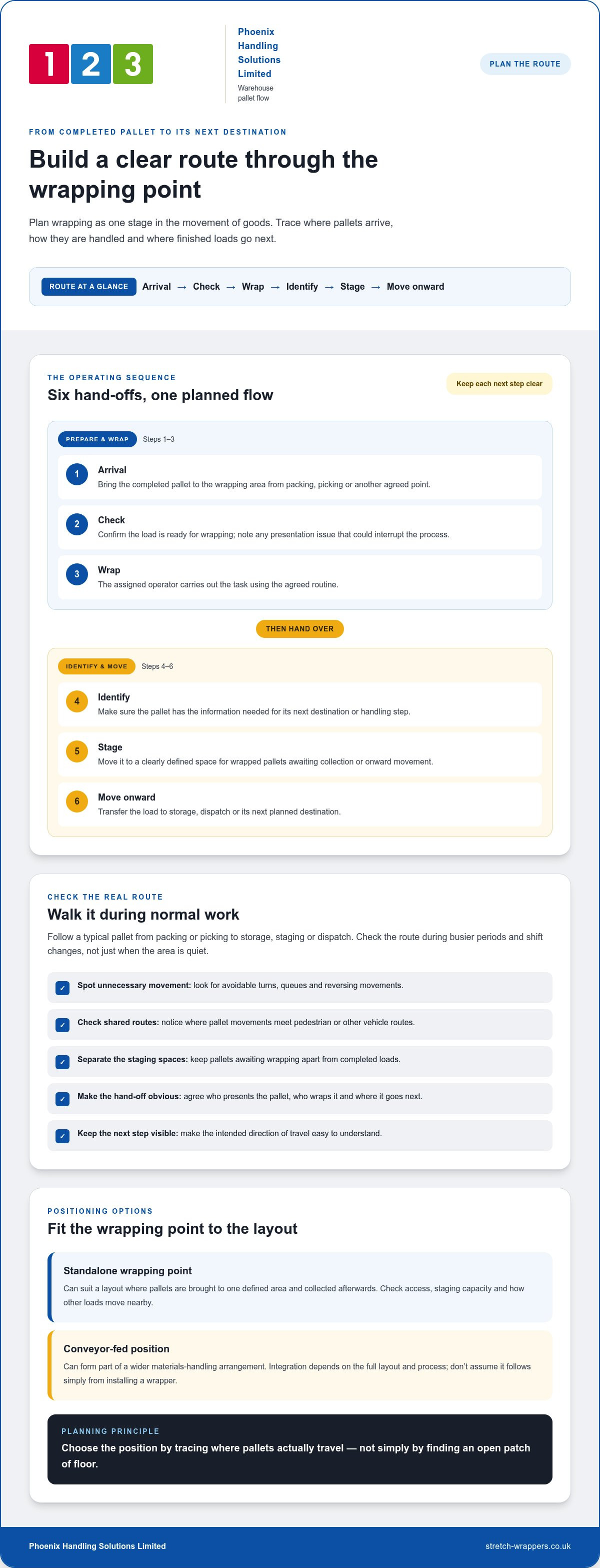
Choose a wrapping position by tracing where pallets actually travel, not just by finding an open patch of floor. Follow a typical load from packing or picking to its next storage, staging or dispatch point. Look for avoidable turns, queues, reversing movements and routes shared with pedestrians or other vehicles. A well-planned position makes the next step clear and helps prevent wrapping from becoming a new bottleneck.
In a straightforward warehouse flow, the pallet arrives, is checked, wrapped, identified, staged and then moved to storage or dispatch.
- Arrival: Bring the completed pallet to the wrapping area from packing, picking or another agreed point.
- Check: Confirm the load is ready for wrapping and note any presentation issue that could interrupt the process.
- Wrap: The assigned operator carries out the wrapping task using the agreed routine.
- Identify: Make sure the pallet has the information needed for its next destination or handling step.
- Stage: Move it to a clearly defined space for wrapped pallets awaiting collection or onward movement.
- Move onward: Transfer the load to storage, dispatch or its next planned destination.
Fit this sequence to the routes warehouse teams already use. A standalone wrapping point can suit a layout where pallets are brought to one defined area and collected afterwards. A conveyor-fed position can form part of a wider materials-handling arrangement, but integration depends on the full layout and process. Don’t assume it follows simply from installing a wrapper. Check how each option affects access, staging capacity and the movement of other loads.
Walk the route during normal work, including busier periods and shift changes. Look for pallets waiting in travel lanes, vehicles needing to reverse near the wrapping point, and pedestrian routes crossing load movements. Keep space for pallets awaiting wrapping separate from space for completed loads, and make the intended direction of travel easy to understand. For a general reference on material-handling principles, see OSHA’s material-handling guidance. This is US guidance, not UK regulation, so it shouldn’t be treated as a statement of UK requirements.
Hand-offs need as much attention as the floor plan. Decide who presents the pallet, who operates the wrapper and who moves the completed load. Make clear how those duties are covered when staffing changes. A simple staging method, such as separate marked areas for “awaiting wrapping” and “ready to move”, can reduce uncertainty. At shift handover, pass on unfinished loads, exceptions and any issue that has held up the process.
A pallet wrapper for warehouse operations should fit the real routes and responsibilities at your site. If you’re considering how different stretch wrapper arrangements could suit your flow, start with the journey each pallet needs to make and the space available around it.
Which pallet wrapper operating approach suits your warehouse?
The right operating approach depends on how pallets arrive, how often they need wrapping and how much of the task your team should manage. Compare the routine across a typical shift, including busy periods and workload changes, rather than choosing automation on volume alone. A pallet wrapper for warehouse operations needs to fit both the work pattern and the available space.
| Approach | Operator involvement | Workflow and space | Pallet presentation |
|---|---|---|---|
| Manual | The operator carries out the wrapping by hand. | Requires a wrapping area and time for the task; equipment integration is not part of the process. | Consistency depends on the operator and a repeatable method. |
| Semi-automatic | An operator presents the pallet and handles parts of the wrapping process. | Often works as a defined standalone point, with room needed for the machine, pallet access and movement away. | Loads still need to be presented consistently, and the operating routine needs to be clear. |
| Automatic | The process can involve less direct manual intervention, depending on the equipment and arrangement. | May require closer coordination with conveyors and upstream or downstream handling, affecting the wider layout. | Repeatable load presentation remains important to a reliable process. |
This is a high-level comparison, not a guarantee of the space or staffing a particular machine will need. Allow for access around the equipment and the route pallets take in and out. Then consider whether the current workflow can support the arrangement without creating a new queue. A turntable, rotating arm or ring wrapper describes the machine configuration, while manual, semi-automatic and automatic describe the operating approach. These are related but separate decisions.
When might a semi-automatic wrapper fit the workflow?
A semi-automatic arrangement can suit a standalone process where an operator brings each pallet to the wrapping point, carries out the required operating steps and moves the completed load onwards. Consider how workload varies between shifts, whether an operator can cover the task alongside other duties, and whether there is enough room to present and clear pallets without obstructing other activity. Don’t rely on a published throughput figure as a general expectation: output depends on the machine, load and operating conditions.
When might automatic wrapping be worth evaluating?
Automatic equipment may be worth assessing where pallet flow is repeatable, handling demands are higher and the operation aims to reduce manual intervention. It can also raise layout questions: conveyors, upstream processes and the route for completed loads may need to work together as one system. The OSHA eTool on packaging hazards and solutions discusses manual plastic-wrapping hazards in grocery warehousing. It is US guidance, not a statement of UK requirements. For a fuller assessment, use the operation’s actual flow and model-specific conditions rather than assuming automation alone will resolve delays.
How to prepare the warehouse team and work area for reliable operation
Good preparation makes a new wrapping routine easier to understand and repeat across shifts. Before equipment enters everyday use, agree how the work area will function, what a ready-to-wrap pallet looks like, who owns each task and how operators will learn the machine-specific procedure. Keep engineering installation work separate from this operational preparation and follow the relevant installation guidance.
Use this sequence to prepare the people and process:
- Review the layout: Check pallet approach and exit routes, space for loads awaiting wrapping, and room for completed pallets to move onwards without obstructing normal warehouse activity.
- Describe the loads: Note the dimensions and types of pallets handled, including variation in load shape and presentation. This gives the team a shared picture of what the routine needs to accommodate.
- Agree responsibilities: Define who presents the pallet, operates the wrapper, moves the finished load and responds when a pallet isn’t ready for the usual process.
- Prepare operators: Make sure each operator receives relevant training and understands the normal cycle, work-area boundaries and reporting process before routine operation begins.
What should the work area be ready to accommodate?
Check that pallets can enter and leave the wrapping point using practical routes, with distinct space for waiting and completed loads. Consider how everyday warehouse movements pass the area, and plan clear operator access with suitable separation from surrounding activity. Review the range of pallet sizes and load presentations in the operation, not just the most common example. This helps ensure the layout and agreed process reflect the work the team will actually handle.
Before use, assess the work area and follow applicable UK workplace safety requirements and the machine’s instructions. The appropriate precautions depend on the equipment and site, so don’t rely on a generic checklist in place of a suitable assessment or equipment-specific guidance. This section covers operational readiness, not engineering installation steps.
What should operators know before routine use?
Operators need a shared understanding of their responsibilities, the normal operating sequence and what to do when a load is irregular, damaged or otherwise unsuitable for the usual routine. Set out how to pause the process and report the issue through the site’s established channels, rather than leaving the next shift to discover it. Structured operator training supports consistent use, while clear handover notes help teams communicate unfinished loads and exceptions.
Equipment-specific operating and maintenance procedures should come from commissioning, operator training and the manufacturer’s instructions. Phoenix Handling Solutions provides installation, commissioning and training, helping teams prepare for day-to-day use without confusing warehouse readiness with the technical work of installing machinery. For a pallet wrapper for warehouse operations, this joined-up preparation helps the equipment fit within a process people understand.
Prepare your team and work area around the equipment with pallet wrapper installation, commissioning and operator training from Phoenix Handling Solutions.
Keep pallet wrapping dependable with the right equipment and support
A suitable wrapper fits the way your warehouse handles pallets day to day. Workload matters, but so do the route loads take through the site, the level of operator involvement your team can support and the floor space available for the machine and surrounding movements. Bringing these factors together helps you choose an arrangement that fits the work, rather than asking the workflow to adapt around unsuitable equipment.
Machine configuration is another part of the decision. Rotating turntable, rotating arm and ring stretch wrappers are distinct equipment categories, and the right arrangement depends on the operation and loads involved. Don’t choose on category name alone. Consider how pallets are presented, where wrapping sits in the process and how completed loads leave the area. Phoenix Handling Solutions can help relate these practical requirements to its pallet wrapping machinery range.
What support helps a wrapper settle into warehouse use?
Equipment is only one part of a reliable set-up. Installation and commissioning prepare the supplied machinery for operation, while structured operator training helps staff learn the equipment-specific routine. Maintenance training can also help the team understand its responsibilities for ongoing care, with machine instructions guiding day-to-day use.
Support continues beyond the initial set-up. Phoenix Handling Solutions provides machine servicing, service contracts and genuine replacement spare parts to help warehouse teams maintain their wrapping equipment over time. The appropriate support arrangement depends on the machinery and the needs of the operation. Consider ongoing care as part of the equipment decision, rather than leaving it until a routine is already established.
How can Phoenix Handling Solutions help with the next step?
Phoenix Handling Solutions supplies industrial pallet wrapping machinery across the UK, including rotating turntable, rotating arm and ring stretch wrappers. The business also provides installation, commissioning, operator and maintenance training, alongside servicing, service contracts and spare parts. PHS is the UK sales agent for Tosa S.P.A. stretch-wrapping machines.
To make an equipment discussion practical, bring together the details that shape your workflow: the pallet types and workload you handle, how loads move through the warehouse, the staffing available for wrapping and the space around the proposed location. These details help define the operating requirements without assuming that one level of automation suits every site.
If you’re reviewing your wrapping process, discuss your warehouse’s load flow, operating requirements and suitable equipment approach with Phoenix Handling Solutions. A practical conversation can help you work through the key considerations and the support needed to bring a pallet wrapper for warehouse operations into the daily routine.
Take the next step towards a better-fitting wrapping process
Base your next decision on the work your warehouse needs to do, not on the assumption that more automation is always better. Use what you know about pallet flow, load types, staffing and available space to identify where the process could work more smoothly. A pallet wrapper for warehouse operations should fit the people and movements around it, as well as the wrapping task itself.
Phoenix Handling Solutions supplies pallet wrapping machinery across the UK, with support that includes installation, commissioning, operator training, servicing and spare parts. Consider the equipment and the support needed to bring it into everyday use together, while keeping your warehouse’s needs at the centre of the decision.
Ready to explore an approach that fits your operation? Talk through your warehouse wrapping requirements with our team and plan the next step around the way your warehouse works.
Frequently Asked Questions
What does a pallet wrapper do in warehouse operations?
A pallet wrapper applies stretch film around a palletised load to help hold the goods together during handling and onward movement. In warehouse operations, this supports preparation for storage, staging or dispatch and can make wrapping less dependent on each person’s individual technique. The suitable routine depends on the load and equipment, so follow the machine instructions and agreed site procedures for the pallets being handled.
Is a pallet wrapper suitable for a small warehouse?
Yes, a pallet wrapper can suit a small warehouse if the chosen arrangement fits its workload and available floor space. Consider how often pallets need wrapping, the space required to bring loads in and move them out, and whether an operator can manage the process alongside other tasks. A compact operation may favour a standalone approach, but the actual pallet route and load types should guide the decision.
How do I choose between a semi-automatic and automatic pallet wrapper?
Choose by comparing operator involvement with the way pallets move through the site. A semi-automatic approach involves an operator presenting and handling each load, while an automatic system may suit a repeatable flow where reduced manual intervention is a priority. Consider staffing across shifts, workflow changes and space for connected equipment. Assess throughput against the relevant machine, load and operating conditions, rather than treating a general figure as a promise.
Can a pallet wrapper be integrated with an existing warehouse workflow?
Yes, a wrapper can be planned around an existing workflow, although the arrangement depends on the site. For example, a warehouse might position a standalone wrapper after packing, with a defined space for wrapped pallets awaiting dispatch. A conveyor-fed position involves the wider handling system, so upstream supply, downstream collection and any waiting points need to be considered together. Mapping a typical pallet journey can reveal whether integration simplifies handling or adds complexity.
What should operators be trained to do on a pallet wrapper?
Operators should learn the equipment-specific operating sequence, how to present loads, how to use the controls and what to do if a pallet or cycle is irregular. Training should also explain their responsibilities during normal operation and how to report a fault or concern through site procedures. Machine instructions remain the reference for particular equipment, including any operator checks or maintenance tasks that form part of the approved routine.
How can warehouse teams improve consistency when wrapping pallets?
Agree a standard method for preparing and presenting loads, then make sure operators follow the same equipment instructions and routine. For example, teams can record recurring issues such as an uneven load or a cycle that needs attention, rather than allowing each shift to develop its own workaround. Review wrapped pallets against the site’s expectations and use operator feedback to refine the process without changing machine settings outside the relevant instructions.
Who can install and commission a pallet wrapper in the UK?
Phoenix Handling Solutions Limited supplies industrial pallet wrapping machinery across the UK and provides installation and commissioning for supplied equipment. Its support also includes operator and maintenance training, helping teams prepare to use and care for machinery as part of warehouse operations. PHS supplies rotating turntable, rotating arm and ring stretch wrappers, and is the UK sales agent for Tosa S.P.A. stretch-wrapping machines.


