

The fastest machine is not always the right fit for a busy packing line. An automatic strapping machine feeds and applies the strap without an operator feeding it by hand. With a semi-automatic model, the operator feeds the strap before the machine tensions and seals it.
Choosing between them involves more than speed. Pallet volumes, available floor space and packaging type all affect what will work in your operation. We’ll cover how to assess those practical needs, compare machine options and plan for installation, training and ongoing support, so the equipment suits both your packing process and the people operating it.
Key Takeaways
- Match operator involvement to your packing flow: semi-automatic equipment needs manual strap feeding, while automatic models feed and apply the strap themselves.
- Assess package volume, required tension and space around the line together to identify a suitable high-throughput setup.
- Compare polypropylene and polyester strapping against the load and the machine’s requirements before settling on a format.
- Plan for installation, commissioning and operator training alongside the equipment, so the system fits your operation from the outset.
What strapping machine do I need?
Start with the product or pallet, the volume you handle and the space around the packing point. The right machine depends on how much operator involvement your workflow can accommodate.
Choosing a machine type
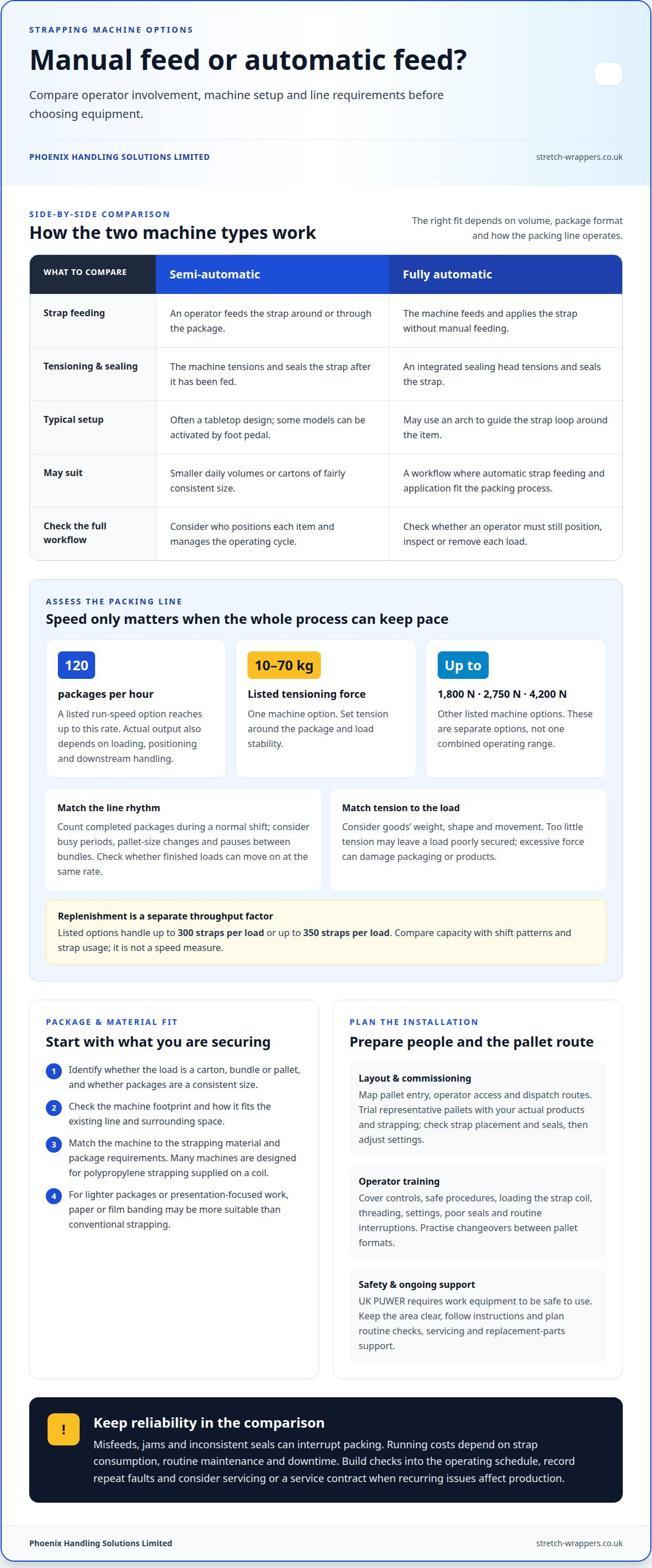
Automatic and semi-automatic machines suit different packing routines. A semi-automatic model typically has a tabletop design, while fully automatic equipment may use an arch to loop strapping around a product. Consider whether you’re securing cartons, a bundle or a pallet, and whether packages are a consistent size. Also check the machine’s footprint and how it will fit into your existing line.
Strapping material matters too. Many machines are designed for polypropylene strapping supplied on a coil, so match the equipment to the material and package requirements. For lighter packages or presentation-focused work, paper or film banding may be more suitable than conventional strapping.
Comparing operator involvement
With semi-automatic operation, an operator feeds the strap around or through the package; the machine then tensions and seals it. Some models can be activated with a foot pedal, allowing the operator to position each item and manage the cycle. This approach can suit smaller daily volumes or cartons of a fairly consistent size.
A fully automatic system feeds and applies the strap without manual feeding. An integrated sealing head tensions and seals the strap, while an arch guides the loop around the item. For a pallet line, assess how packages reach the machine and whether an operator still needs to position, inspect or remove each load. Compare the whole workflow, not just the strapping cycle.
Assessing safety requirements
In the UK, PUWER requires work equipment to be safe to use, regardless of its age, condition or origin, according to the UK Government. Operators should understand the machine’s controls, safe working procedures and the risks around its moving parts before use. Keep the operating area clear and follow the equipment’s instructions.
Strap misfeeds, jams and inconsistent seals can interrupt packing and need attention. Running costs depend on factors such as strap consumption, routine maintenance and downtime. Regular checks can help maintain reliable operation. If recurring faults affect production, servicing or a service contract can support planned maintenance and help address wear before it disrupts the line.
High-volume and high-speed strapping
For busy pallet lines, compare the machine’s cycle with the full packing process. It needs to keep pace with loading, strap application and sealing.
Evaluating strapping speed
A listed run-speed option reaches up to 120 packages per hour, but that figure is only useful alongside your actual workflow. Check how packages arrive, how quickly staff can position each load, and whether downstream handling can accept finished pallets at the same rate. Manual loading or pauses between bundles can limit line output, even when the strapping cycle is fast.
Count completed packages during a normal shift, then account for busy periods and changes in pallet size. Choose a machine whose speed suits the line’s steady rhythm, rather than focusing only on its fastest cycle. Check how strap feeding, application and sealing fit each load’s movement, and identify where a bottleneck might develop.
Considering strap tension
Tension affects how firmly the strap holds a load, so choose settings around the package and its stability. Listed machine options include tensioning force from 10 to 70 kg, alongside options reaching up to 1,800 N, 2,750 N or 4,200 N. These are different machine options, not figures to combine as one operating range.
Consider the weight, shape and movement of goods on each pallet. Too little tension may leave a load poorly secured, while excessive force can damage packaging or products. Check whether the machine applies tension and seals consistently across the bundles you handle.
Replenishment also affects throughput. Listed machine options can handle up to 300 straps per load or up to 350 straps per load, reducing how often an operator needs to reload during production. Compare this capacity with your shift pattern and strap usage, rather than treating it as a speed measure.
Finally, map the full pallet route, from strapping through to wrapping and dispatch. Where a line also needs wrapping, pallet wrapping equipment can be considered as part of the overall flow, helping you assess how one stage feeds the next.
Installation, training and after-sales support
Plan installation around the packing line, not just the machine footprint. Map pallet entry, operator access and the route to dispatch before positioning equipment. This can reveal awkward hand-offs, restricted working space and places where finished loads may queue. Include nearby equipment, such as conveyors or wrapping stations, in the layout.
During commissioning, run the machine with your actual product mix and strapping. Trial representative pallets, check strap placement and seals, then adjust settings to suit the load. A useful handover records the agreed operating method and shows operators how to start and stop the machine and safely clear routine interruptions.
Training helps operators manage automatic banding across shifts. They should practise loading the strap coil, threading the machine, selecting settings and recognising a poor seal. Include changeovers between pallet formats, so the process does not depend on one experienced team member being present.
Ask how after-sales support covers recurring faults, routine servicing and replacement parts. A misfeed, worn sealing component or damaged strap guide can interrupt productivity, so clear fault-reporting steps help staff describe the issue accurately. Before reporting a problem, record the symptoms, machine settings and load involved.
Build routine checks into the operating schedule. Operators can keep the machine and surrounding area tidy, inspect the strap path and report changes in seal quality. Maintenance staff can use service records to spot repeat faults and plan work around production demands, rather than waiting for a stoppage.
Before signing off the installation, run through a complete cycle with the people who will use the equipment. Confirm each operator can prepare a load, run the sequence and respond to a routine interruption. Assess installation, commissioning, training and support together, because each can affect reliable packing and readiness for dispatch.
How do polypropylene and polyester strapping compare for automatic machines?
Match the strapping material to both the load and the machine. Many machines are designed for polypropylene strapping supplied on a coil. Polyester options must also suit the machine’s feed and sealing setup. Check the specified material and width before selecting a coil.
Listed strength figures offer examples, but they aren’t direct comparisons unless widths and conditions match. A 13 mm polypropylene strap has a stated strength of 100 Kg, while a 15 mm polypropylene strap is stated at 250 Kg. For polyester, 13 mm PET is stated at 200 Kg, and 16 mm PET at 380 Kg.
Material names alone do not determine suitability. Compare the stated strength for the exact width, then consider the load’s weight, shape and handling. A stable, uniform pallet and a mixed load may need different strapping choices, even if both use the same machine.
Use this practical selection sequence:
- Identify the load type, packaging and expected handling during transit.
- Match the required strap width and material to the machine’s specifications.
- Compare stated strength figures for the exact strap format, not different widths.
- Run a representative bundle through the machine and inspect strap placement and sealing.
For example, don’t treat 15 mm polypropylene at 250 Kg as directly equivalent to 16 mm PET at 380 Kg. The figures describe different materials and widths, so they help frame a comparison rather than establish a universal choice. Check that the chosen strap feeds reliably and forms a secure seal on your actual packaging.
Keep the selected strap specification with the machine’s operating information. That gives operators a clear reference when changing coils or investigating inconsistent seals. If you’re reviewing strapping and wrapping equipment together, discuss your packaging equipment requirements with the team.
Phoenix Handling Solutions Limited: Rotating turntable stretch wrappers
Phoenix Handling Solutions Limited supplies Tosa strapping and pallet-wrapping machinery. If pallet strapping is part of a wider packing-line decision, its rotating turntable, rotating arm and ring stretch wrappers provide different ways to secure pallet loads with stretch film after strapping.
Consider the hand-off between strapping and wrapping: how pallets reach the wrapping stage, how much floor space is available, and whether the load suits a turntable, rotating arm or ring system. Phoenix also provides installation, commissioning and training, helping operators understand the equipment and its place in the packing process.
Planning pallet wrapping alongside your strapping setup? Contact Phoenix Handling Solutions Limited to discuss your requirements.
Plan the next step for your packing line
Choosing an automatic strapping machine is an opportunity to review how each pallet moves through packing, from securing the load to preparing it for dispatch. Mapping the full route can help you plan equipment around your available space, handling process and packaging needs.
If stretch wrapping is the next step, Phoenix Handling Solutions Limited supplies rotating turntable, rotating arm and ring stretch wrappers, with installation, commissioning and training. Start with your actual packing layout: how pallets arrive, where operators work and how wrapped loads leave the area.
Use those details to shape a practical discussion about the equipment and support that fit your operation. Explore packaging equipment with Phoenix Handling Solutions Limited, and take the next step towards a packing line that works for your team.
Frequently Asked Questions
Are these machines suitable for securing boxes and cartons?
Yes, strapping machines can secure boxes and cartons, particularly when packages are stable and presented consistently. A dispatch line handling similar-sized cartons, for example, can benefit from repeatable strap placement. Check that each carton fits the machine’s working area and that strap pressure will not crush its contents. For mixed formats, consider how staff will align each package between cycles.
What is an automatic strapping machine and how does it work?
An automatic strapping machine forms and seals a strap loop around a product, with the machine handling the strap feed. The package still needs to be presented correctly at the strapping point, by conveyor or operator. For pallet operations, consider how a forklift or conveyor delivers and clears each load, as these movements shape the line layout and workflow.
What types of automatic strapping equipment are available?
Common options include semi-automatic tabletop machines and fully automatic arch-style systems. Tabletop equipment suits smaller packages an operator can position individually, while an arch system can apply a loop around products moving through a packing point. This distinction helps determine whether a worker handles each package or the machine becomes part of an integrated line.
Which machine is best for different package sizes and production volumes?
An automatic strapping machine may suit operations with a consistent production flow, while a semi-automatic model can work for individual handling tasks. Consider peak demand, package changes and the space staff need to load or remove items. A practical trial using representative loads can reveal alignment or handling issues that a specification sheet alone may not show.
What machine speed and strap tension should I look for?
Match the machine’s speed to the slowest stage around the strapping point, such as loading or moving completed pallets away. Set tension according to load stability and packaging strength: a fragile carton needs different handling from a dense bundle. Test the intended strap on real packages, then check that the load stays secure without crushed corners, loose loops or poor seals.
What UK suppliers sell automatic strapping machines and provide installation or servicing?
Phoenix Handling Solutions Limited supplies Tosa strapping and pallet-wrapping machinery, with installation, commissioning, operator training, servicing, service contracts and spare parts support. Its engineers cover the whole of the UK and Ireland. If you’re planning a new strapping point or need ongoing machinery support, share your application, package formats and line layout with the Phoenix team to discuss a practical solution.


