

Turning up the wrapper speed can make a slow pallet line look faster, but it won’t necessarily make the whole operation more efficient. If film use and wrap quality vary between shifts, or wrapping is holding up dispatch, start by reviewing the process from load preparation to the finished pallet. To improve pallet wrapping efficiency, balance throughput with consistent film application and secure load containment, rather than simply asking the machine to work faster.
When wrapping takes too long, machine settings are an obvious place to look, but small changes can affect both film use and load stability. This guide explains how to identify wasted time and inconsistent results, what to monitor when adjusting film application, and how to check that a load remains properly contained. It also covers operator training, maintenance and machinery selection, so you can make controlled improvements and recognise when process or equipment support could help.
Key Takeaways
- Measure efficiency through throughput, consistent containment, film use and safe working practices, not cycle speed alone.
- Check how pallet loading, film threading, roller condition, overlap and stretch interact before changing machine settings.
- Record a representative baseline and compare film breaks, repeated wrapping and unstable loads to locate waste.
- To improve pallet wrapping efficiency, test one adjustment at a time, then inspect and record its effect on the finished load.
- When routine checks aren’t enough, suitable machinery, operator training, servicing and spare parts can support a more consistent process.
What does pallet wrapping efficiency mean beyond wrapping more pallets per hour?
A wrapper can complete more cycles in an hour and still waste film, create rework or leave loads less secure. A useful measure of efficiency balances throughput with repeatable containment, controlled film use and safe operator practice. If any one of these falls away, a faster cycle may simply move the problem further down the line.
Wrapping speed is the rate at which the machine completes cycles; overall process efficiency is how reliably it produces secure, consistently wrapped pallets with appropriate film use and minimal interruption. This distinction gives teams a sound basis for deciding where to focus to improve pallet wrapping efficiency. For context, stretch wrap is applied in different ways to secure pallet loads, so results depend on more than the machine’s cycle rate.
Which measures show whether pallet wrapping is efficient?
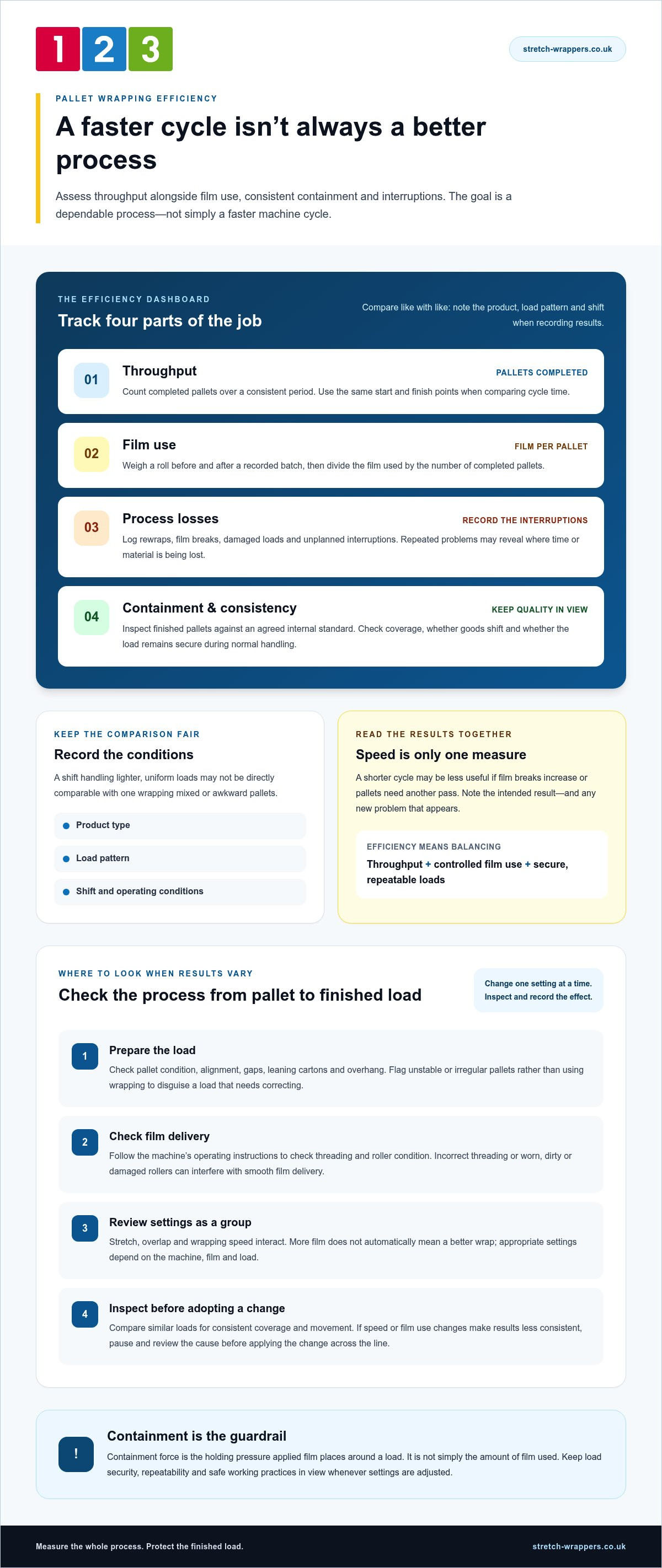
Start with a representative period and record the operating conditions alongside the results. A shift handling lighter, uniform loads may not be directly comparable with one wrapping mixed or awkward pallets, so note the product type, load pattern and shift. Use the same start and finish points when measuring cycle time to make comparisons useful.
- Throughput: count completed pallets over a consistent period, noting product and shift differences.
- Film use: measure film consumed per pallet using the same method each time. For example, weigh a roll before and after a recorded batch, then divide the film used by the number of completed pallets.
- Process losses: log rewraps, film breaks, damaged loads and unplanned interruptions, rather than treating them as isolated incidents.
Review these measures together to see whether a change improves the process as a whole. A shorter cycle is less useful if film breaks become more frequent or pallets need another pass. Note both the intended result and any new problem that appears.
Why load stability must remain an efficiency measure
A faster cycle isn’t an improvement if the wrapped load is less secure. Loads that vary in shape, height or arrangement can make consistent film application harder. Some pallets may need extra wrapping, while others may be more difficult to handle downstream. The result can be additional checks, rework or product damage, which all undermine the time apparently saved at the wrapper.
Treat containment and repeatability as guardrails for any adjustment. Compare finished loads against an agreed internal standard, checking whether goods shift, film is applied consistently and the pallet remains secure during normal handling. If a change to speed or film use makes results less consistent, pause and review the cause before adopting it across the line. The aim is a dependable process, not a faster machine cycle at any cost.
How load preparation, film application and machine settings affect wrapping efficiency
Consistent wrapping starts before the pallet reaches the machine. If cartons sit unevenly, the load leans or goods extend beyond the pallet, the wrapper has to apply film around an inconsistent shape. That can leave loose areas, put extra strain on the film or prompt operators to add wraps as a precaution. A setting that works for a square, stable load may not suit an irregular one.
Film delivery and machine settings then determine how the film behaves around the load. Threading, roller condition, film stretch, overlap and wrapping speed are connected. A problem with film delivery can affect tension, while changing speed or overlap may alter the finished wrap. To improve pallet wrapping efficiency, consider the load, the operator’s routine and the machine together, rather than treating one setting as a cure-all.
Prepare pallets for repeatable wrapping
Before a cycle, check that the pallet is sound, the goods are aligned and any overhang is accounted for. Group comparable products and load patterns when assessing results, so a change in wrapping isn’t confused with a change in load shape or weight. Flag leaning, unstable or irregular pallets for attention before adjusting the machine. Wrapping shouldn’t be used to disguise a load that needs correcting.
- Pallet condition: note broken or uneven deck boards that could affect stability or film application.
- Load alignment: check for leaning cartons, gaps or a top layer that shifts during handling.
- Overhang: record where goods extend beyond the pallet, as exposed edges may catch or puncture film.
Review film delivery and wrapping settings
With a consistent load, inspect film threading and rollers in line with the machine’s operating instructions. Incorrect threading or worn, dirty or damaged rollers can interfere with smooth film delivery. Operators should follow the correct procedure for the equipment, and inspections or adjustments must be carried out safely.
Next, assess stretch, overlap and wrapping speed as a group, changing settings in a controlled way. Containment force means the holding pressure the applied film places around the load to help keep its contents together. It isn’t simply the amount of film used. More film doesn’t automatically produce a better wrap, and settings that are too aggressive can affect the load or film. Appropriate values depend on the particular machine, film and load, so avoid applying a universal figure.
Check the finished pallet for consistent coverage and movement, then compare results across similar loads. Keep operators aligned on threading and load preparation, since differences in practice can make a sound machine setup appear inconsistent. For a general reference on machine and material-handling precautions, OSHA safety guidelines are useful. UK workplaces should follow applicable UK requirements and their own procedures.
Phoenix Handling Solutions supplies stretch wrapping machinery, including rotating turntable, rotating arm and ring stretch wrappers. The right type of machine depends on the loads and operating requirements.
How to diagnose the biggest sources of pallet wrapping inefficiency
Before changing a setting or asking operators to work faster, establish what the current process does. Record a representative baseline across comparable pallet types and shifts. Note completed pallets, cycle times, film breaks, rewraps, load issues and interruptions, along with the conditions around each result, such as product pattern, operator intervention and machine condition. This gives you a reliable comparison and helps avoid attributing a normal change in workload to a machine fault.
Look for recurring patterns rather than treating each problem as a separate incident. A longer cycle may be caused by waiting for a pallet, a slow wrapping sequence or difficulty removing the finished load. Repeated wrapping could point to inconsistent loads, application settings or an unclear work routine. Keep measurement methods consistent, as reflected in NIST standards guidance: measurements are more useful when the method is repeatable.
Match visible problems to likely process causes
Use symptoms to guide the investigation, not to jump to a single conclusion. The same visible issue can arise from equipment, film, load preparation or workflow, so check the surrounding process before deciding what to change.
- Frequent film breaks: observe the film path and threading, check for snags or inconsistent delivery, and note when and where breaks occur. Review operator observations and film condition before adjusting settings.
- Variable containment: compare load alignment and shape, then check whether film application is consistent for similar pallets. Separate changes in load pattern from changes in machine setup.
- Slow output: watch the full sequence, including pallet arrival, loading, the wrapping cycle and removal. A short machine cycle won’t improve throughput if pallets queue before the wrapper or finished loads wait to leave.
- Repeated wrapping or unstable loads: inspect the load and applied wrap together, and record whether the issue affects one pallet type or appears across the line.
This approach helps distinguish equipment condition from film delivery, load preparation and workflow. Don’t assume that a film break automatically means the wrapper needs adjustment, or that a long cycle is caused by the machine itself.
Use operator observations to find recurring friction
Operators see where the process catches. Ask where they wait, intervene, repeat a step or encounter film problems, then compare answers across shifts and similar pallet types. Record the time, load pattern and machine conditions alongside each observation. If one shift reports more interruptions, look for differences in workload or routine before drawing a conclusion.
Once the likely cause is clearer, prioritise the issue that most consistently affects safe, reliable output. Then use the controlled improvement routine below. This measured approach helps you improve pallet wrapping efficiency without changing several parts of the process at once and losing sight of what made a difference.
A practical routine for improving pallet wrapping efficiency safely
Once you’ve identified a recurring issue, make improvements through a controlled trial rather than changing several settings at once. Keep load security and safe handling as firm limits. If a trial makes pallets less stable or creates an unsafe task for operators, stop and reassess before continuing. A measured routine shows what changed and whether the result holds across comparable loads.
- Set a baseline. Record the current result for the issue you want to address, such as cycle time, film breaks or rewraps, alongside load type and operating conditions.
- Observe the process. Follow the pallet from preparation through wrapping and removal. Note waiting, operator interventions and differences between loads.
- Select one change. Choose a single process step or machine variable relevant to the observed problem. Avoid making unrelated adjustments at the same time.
- Test comparable loads. Run the trial on similar pallets under conditions that are as consistent as practicable, and keep normal safe operating procedures in place.
- Inspect the result. Check the finished loads for consistent wrapping and stability, as well as the measure you selected, such as cycle time or film use.
- Record and decide. Compare the trial with the baseline, noting the change made and any side effects. Adopt it only if the overall result is suitable.
Run a controlled wrapping trial
Be clear about the problem and desired outcome before starting. If film breaks are recurring, for example, record how often they happen during a representative baseline, then trial one relevant adjustment while keeping the load pattern and operating conditions as similar as possible. Document who made the change, what was adjusted and what happened. If containment worsens or handling becomes unsafe, stop the trial rather than pursuing a faster cycle or lower film use.
One successful pallet isn’t enough to establish a dependable change. Compare a suitable run of similar loads, accounting for differences in product, shift or operator practice. If results vary, investigate those conditions before deciding whether the adjustment is effective.
Turn effective changes into a repeatable process
Once the result is consistent, write the agreed operating steps in clear instructions. Explain the reason for the change, whether it concerns load preparation, film threading or a machine setting, so operators can recognise when the process has drifted. Share the update across shifts and review performance after it’s introduced. Revisit the instructions if load types or production requirements change.
For adjustments involving machine configuration or operator technique, commissioning and training can help establish consistent working practices. Phoenix Handling Solutions installs and commissions supplied wrapping machinery and provides operator training. If you’re reviewing equipment for your loads and production flow, discuss suitable stretch wrapping machinery with Phoenix Handling Solutions.
When machinery, training or service support can improve wrapping efficiency
Process changes have limits. If loads are prepared consistently and operators follow an agreed routine, yet the wrapper remains a bottleneck, review the equipment’s capacity, configuration and condition. The aim isn’t to replace a machine simply because a line feels busy. First establish whether it suits the loads being handled and the production flow it needs to support.
Recognise when process improvements may not be enough
Look for recurring delays that remain after avoidable waiting and inconsistent practices have been addressed. The wrapper may struggle to accommodate the dimensions or pattern of regular loads, or the way pallets arrive and leave may not suit the line arrangement. These are useful reasons to review the whole application. Assess load dimensions, typical pallet patterns, required throughput and how the wrapping stage connects with upstream and downstream operations. Expected output depends on the application, so don’t assume a particular machine or adjustment will deliver a fixed rate without that assessment.
Equipment condition matters too. If performance changes over time, or interruptions continue despite consistent operation, servicing can help identify whether machine condition or worn components are contributing. Keep a record of recurring faults and interruptions to create a clearer starting point for reviewing support or equipment changes.
Build efficiency into equipment support
Suitable machinery is one part of the picture. Installation, commissioning and operator training help establish how it fits into the working process. Phoenix Handling Solutions supplies rotating turntable, rotating arm and ring stretch wrappers, as well as strapping machines, shrink wrappers and stretch hooders. Machinery selection should take account of the pallet loads and operating requirements. Commissioning supports the operation of supplied machinery within its installation, while operator training helps staff understand the equipment and follow consistent working practices.
Training is most useful when it reflects the actual task. Operators need to understand the agreed process, recognise when a load or wrap differs from the expected result, and know how to report issues rather than compensate with unplanned changes. This helps preserve consistency between shifts and gives the team a practical basis for identifying when conditions have changed.
Ongoing care also supports performance over the machine’s working life. Phoenix Handling Solutions provides preventative maintenance programmes, service contracts and genuine replacement spare parts to support machinery and its maintenance needs. Keeping servicing in view can make recurring performance issues easier to investigate before they become a regular disruption.
To improve pallet wrapping efficiency, consider the process evidence alongside the machine, its condition and the way it’s used. If you’re reviewing a bottleneck or planning a change to your wrapping operation, Phoenix Handling Solutions can discuss your loads, production flow and equipment requirements, as well as suitable installation, commissioning, training and ongoing support.
Choose the next improvement that fits your operation
The most useful next step isn’t necessarily a major change. It may be agreeing a clear performance target, giving operators a consistent way to record results or reviewing whether the current wrapping setup still suits the work passing through the line. Choose one practical priority and build from there, keeping dependable load containment and safe working practices at the centre of any decision.
If your equipment needs reviewing, Phoenix Handling Solutions supplies pallet wrapping and packaging machinery across the UK, with installation, commissioning, operator training, servicing, service contracts and spare parts. Start with your loads and production flow, rather than a predetermined machine or setting. A focused discussion can help turn observations from the line into a considered plan to improve pallet wrapping efficiency.
Talk through your pallet wrapping requirements with Phoenix Handling Solutions and take a practical next step towards a more consistent wrapping process.
Frequently Asked Questions
How can I reduce stretch film use without making pallets less stable?
Review the application on a consistent group of loads, then make small, controlled adjustments within the machine and film instructions. For example, compare film consumed across similar pallets before and after a change, and inspect the finished loads for movement or loose areas. Don’t simply remove wraps or lower settings based on appearance alone. The aim is to improve pallet wrapping efficiency while keeping loads secure through normal handling.
How often should a pallet wrapping machine be checked?
Follow the machine manufacturer’s operating and maintenance instructions, since checks depend on the equipment and how it’s used. Operators can look for visible issues during routine use, such as film not travelling smoothly or a change in the machine’s normal behaviour, and report them promptly. Keep maintenance records so recurring faults are easier to spot. Any inspection or adjustment should follow the equipment instructions and the site’s safe working procedures.
What is containment force in pallet wrapping?
Containment force is the holding pressure the applied film exerts around a load to help keep its contents together. It depends on how the film is applied and the characteristics of the load, so using more film doesn’t automatically mean better containment. Compare similar finished pallets for consistent coverage and movement during normal handling, following your site’s criteria for an acceptable, secure load.
Can different pallet loads use the same wrapping settings?
Sometimes, but don’t assume one setup suits every load. Similar, regularly shaped pallets may perform consistently with the same settings, while a taller, lighter or irregular load may respond differently. Group loads by relevant features, such as dimensions, arrangement and stability, then assess the wrap on each group. If a load type needs frequent manual intervention or extra wrapping, treat it as a separate case rather than changing settings for the whole line.
Why does a pallet wrapper keep breaking the film?
Repeated film breaks can have several causes, so note where in the cycle each break occurs. Check that the film is threaded as instructed and observe whether it catches along its path. Consider load corners or protrusions that may snag it, as well as roller condition and the interaction between film delivery and machine settings. If breaks persist after basic checks, record the pattern and arrange appropriate machine servicing.
Does automating pallet wrapping always improve efficiency?
No. Automation can support a more consistent process, but it won’t solve every delay if pallets arrive unevenly, the line layout causes queues or the machine doesn’t suit the load pattern. Consider the full operation, including how loads reach the wrapper and leave it, as well as the support operators need to use the equipment consistently. Compare the expected process with current performance before deciding whether a machinery change is appropriate.
What should be recorded during a pallet wrapping efficiency trial?
Record the trial’s purpose, the process or setting changed, the load type, the shift and the machine conditions. Track the measure you’re trying to improve, such as film use or cycle time, alongside film breaks, rewraps, interruptions and any sign of reduced load stability. Compare similar pallets with the baseline and note operator observations. This makes it easier to see whether the change helped overall or simply moved the problem elsewhere.


