

The turntable vs rotating arm wrapper decision isn’t simply about choosing the faster machine. Start by asking whether your pallet can rotate safely. Turntable wrappers generally suit stable, evenly distributed loads and need less floor space, while rotating arm wrappers keep the load stationary, making them a better fit for heavy, unstable or irregular pallets. Turntables typically have lower capital and installation costs, but throughput and the machine’s fit with your operation matter too.
It’s understandable to focus on purchase cost or wrapping speed, but either can be misleading if the load becomes unstable or the machine needs more room than your site allows. This comparison explains how load stability, daily volume, footprint and whole-operation costs shape the decision, including the practical trade-offs between the two systems. You’ll also find a decision guide to help match your pallet profile and production needs to the wrapper type that makes sense for your operation.
Key Takeaways
- Start by identifying whether pallets are stable enough to rotate, or whether keeping the load stationary would better protect it during wrapping.
- Allow for loading, unloading and operator access when comparing machine footprints, not just the wrapper’s floor space.
- Match the wrapper’s cycle and level of automation to your production flow, rather than relying on headline speed alone.
- Compare the wider operating demands, including film use, labour, load damage risk and servicing, alongside the initial investment.
- Use the decision guide to weigh your pallet profile, throughput needs, available space and budget before selecting a wrapper type.
Rotary Arm Pallet Wrapper vs Turntable Wrapper: Which Is Right For Your Operation?
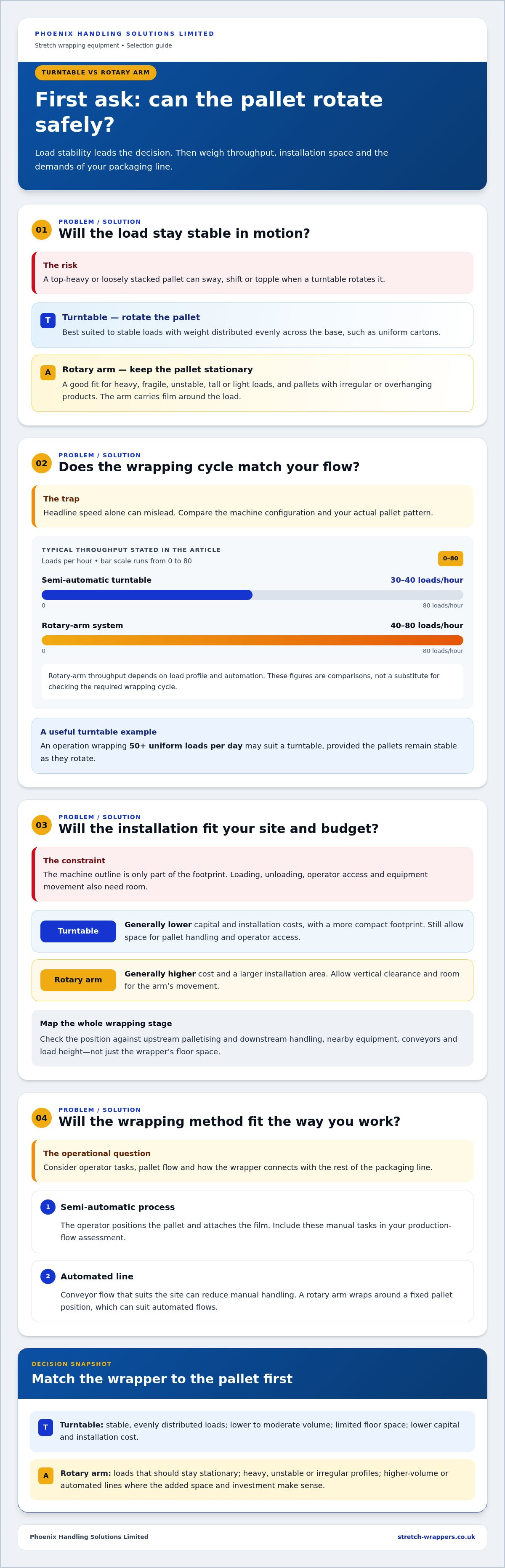
Start by checking whether a pallet can rotate without losing stability. Then consider required throughput, available space and budget. Assess the load profile alongside the packaging line, since the wrapping cycle must protect products and keep pace with the operation.
Turntable wrappers
A turntable wrapper rotates the pallet as film is applied, so it generally suits stable loads with weight distributed evenly across the base. A standard pallet of uniform cartons is a straightforward example. Heavy, top-heavy or loosely stacked products can shift during rotation, making stability a key selection factor. Turntables generally have lower capital and installation costs and a more compact footprint than rotary-arm systems.
Rotary-arm wrappers
A rotary-arm wrapper moves the film around a stationary pallet, avoiding the need to rotate heavy, fragile or unstable products. It can suit tall, light, irregular or overhanging loads that would be difficult to turn safely. Rotary-arm systems generally cost more and need more installation space and vertical clearance. Their potential for higher throughput can make that trade-off worthwhile in a high-volume packaging line or automated operation.
Throughput helps narrow the choice, but compare machine configuration and your actual load pattern. Semi-automatic turntables typically process 30-40 loads per hour; rotary-arm systems typically process 40-80, depending on load profile and automation. For example, an operation wrapping 50+ uniform loads per day may suit a turntable, provided those pallets remain stable as they rotate. Those figures are useful comparisons, not a substitute for assessing the required wrapping cycle.
For the turntable vs rotating arm wrapper decision, weigh these criteria against your pallets and packaging line:
| Option | Load profile | Throughput | Capital cost | Footprint |
|---|---|---|---|---|
| Turntable | Stable, evenly distributed pallets | Suitable for low- to medium-volume work | Generally lower | Generally more compact |
| Rotary arm | Heavy, unstable, irregular or overhanging loads | Often suited to higher-volume lines | Generally higher | Generally larger, with vertical clearance needed |
Assess the full installation, not just the machine’s outline. A turntable needs space for loading, unloading and operator access, while an arm system also needs clearance for its movement and structure. Map the wrapping stage against upstream palletising and downstream handling. A semi-automatic process involves operator tasks such as positioning the pallet and attaching film. An automated line can reduce manual handling when conveyor flow suits the site.
Choose a turntable when stable loads, moderate volume, limited floor space and capital cost are the main considerations. Choose a rotary arm when the load must stay stationary, or when throughput and integration into an automated line outweigh the larger footprint and investment.
Rotary-arm wrapper suitability for heavy or unstable loads
A rotary-arm wrapper applies stretch film without turning the pallet. The load stays stationary while an arm carries the film around it, reducing movement during wrapping. This makes the system suitable for heavy or unstable products that might shift, lean or topple on a rotating turntable. Tall, light cartons, fragile goods and pallets with overhanging products are examples where keeping the load still can help preserve stability.
Consider how the pallet behaves before choosing a wrapping method. A top-heavy stack can sway as it rotates, while loosely stacked cases may move out of alignment. With a rotary arm, the film travels around the stationary load, so the pallet does not have to complete a rotation. This distinction matters when handling varied load profiles, especially pallets that are difficult to stabilise in motion.
The wrapping action also affects how the machine fits into a packaging line. A rotary arm works around a fixed pallet position, making it suitable for automated flows where pallets arrive by conveyor. Rotary-arm systems are often used in high-volume manufacturing, where throughput and consistent wrapping performance matter. Installation generally needs more room and vertical clearance than a turntable, so assess the machine’s position alongside conveyors, nearby equipment and load height.
A rotary ring offers another way to keep the pallet stationary. Instead of an arm carrying film around the load, a film-carrying circular ring rotates around it. Rotary-ring wrappers are intended for high-throughput operations where wrapping speed and film efficiency are important; some variants can exceed 100 loads per hour. That makes a ring worth considering where production flow demands greater speed, although its process and installation needs differ from a rotary arm.
- Heavy pallet: Keep the load stationary to avoid rotating a weighty stack.
- Unstable profile: Consider an arm or ring for tall, fragile or overhanging products.
- Fast production flow: Compare rotary-arm performance with ring systems designed for high throughput.
- Restricted facility space: Factor in arm movement, vertical clearance and access around the installation.
Rotary arms have a clear advantage when rotation could compromise load stability, but they are not right for every pallet. A stable, evenly distributed load may not need stationary-load wrapping, while a larger installation footprint can complicate a confined facility. Compare the load’s shape and behaviour with the line’s required pace before choosing a method.
If a stationary-load process suits your pallets, explore the available stretch wrapping systems as part of your equipment comparison.
How turntable wrappers rotate pallets during wrapping
A turntable stretch wrapper secures a palletised load by rotating it as stretch film is applied. The pallet sits on a powered platform, and its rotation carries each face past the film carriage. As the carriage moves vertically, film covers the load from the bottom towards the top. The combined rotation and carriage movement create overlapping layers around the pallet.
For a stable load, the wrapping cycle is straightforward: position the pallet centrally, attach the film, then start the cycle. On a semi-automatic machine, an operator usually positions the pallet, attaches the film, starts the cycle and moves the wrapped load. Depending on the machine, settings may include wrap count, film tension and carriage movement. These control how film is applied to the load.
“Pallet wrapper” describes a broad equipment category, not just a turntable machine. Configurations include turntable machines, rotary-arm models, rotating rings, portable wrappers and horizontal systems. Each applies stretch film differently: a turntable rotates the pallet, an arm carries film around a stationary pallet, and a ring rotates around the load. Load shape and stability help determine which action suits the application.
Automation changes how a turntable fits into a packaging line. An automatic wrapper can receive a pallet by conveyor, wrap it, cut and secure the film, then release the load with little or no operator involvement. In a production cell, PLC controls can coordinate conveyor movement, the wrapping cycle and signals from a palletiser. The aim is a reliable handover, so a pallet enters the wrapper only when the receiving position is clear.
A mobile robotic wrapper takes a different route to the pallet. Rather than bringing the load to a fixed turntable, the robot travels to the load and wraps it where it stands, avoiding extra pallet handling. Mobile robotic wrappers typically process 20-30 loads per hour. That makes the format relevant where loads are spread across a facility, although travel routes and access become part of the operation.
Turntables suit stable loads that can rotate without shifting, such as evenly stacked cartons on a standard pallet. Unstable loads need closer consideration because rotation may disturb the stack; a stationary-load method avoids that movement. Compare the wrapper type with the pallet profile, required throughput and material-handling route. Then consider whether operators will bring pallets to a fixed machine or whether a mobile unit should travel between loads.
Throughput, capital cost and footprint comparisons
Film use depends on the wrapper settings, load and stretch-film system, not just whether the pallet rotates. Turntables can use powered pre-stretch to reduce film consumption while maintaining load security. Operating costs also reflect labour, servicing, load damage and throughput. Turntables generally have lower purchase, installation and maintenance costs than rotary-arm systems, but the initial outlay alone does not determine whole-life cost.
For throughput, compare machine configurations and the production flow they must serve. Semi-automatic turntable wrappers typically process 30-40 loads per hour, whilst rotary-arm systems typically process 40-80, depending on load profile and automation. High-speed automatic turntables with dual film carriages can process up to 80-100 loads per hour. Rotary-ring variants can exceed 100 loads per hour, making them another option for demanding production environments.
These figures aren’t a guarantee of output at your site. Pallet profile, film application, loading and unloading, and operator involvement all affect the wrapping cycle. A machine may have the capacity to wrap quickly, but a conveyor bottleneck or manual pallet movement can restrict actual throughput. Compare the full process, from pallet arrival to release, rather than relying on headline speed alone.
Rotary rings use a rotating ring around a stationary load. They can be configured with features such as automatic film cutting, clamp and wipe systems, and load-height sensing. Optional top-sheet application can also be part of the system. These features can suit high-throughput operations, but the installation and automation need to match production requirements.
Footprint affects both installation and daily movement. Turntables are generally more compact, but still need space for loading, unloading and operator access. Rotary arms usually require a larger installation area, vertical clearance, an overhead structure and additional safety guarding. Include pallet approach and exit routes when assessing available floor space.
- Lower volume and stable pallets: A turntable can suit operations prioritising compact layout and lower capital cost.
- Stationary-load wrapping: A rotary arm can suit heavier or unstable pallets and higher-volume production.
- High-speed automated flow: Compare automatic turntables, rotary arms and rings against the line’s required output and integration.
For a fair operating-cost comparison, assess film consumption, labour, maintenance, possible load damage and the value of meeting production demand. Map each machine’s footprint and pallet movement onto the facility layout. The best fit is a configuration that wraps the required load reliably and keeps pace with the line, without adding capacity or installation complexity the operation doesn’t need.
Advantages and limitations of each wrapper type
A turntable and a rotary arm solve different wrapping problems, so the decision is not simply about which machine has more features. Compare load stability, film application, operator tasks, installation space and production flow. Stable cartons, for example, may suit a turntable, while a fragile, top-heavy pallet may benefit from stationary-load wrapping.
Operators should keep clear of moving parts during a wrapping cycle and follow the machine’s guarding and operating instructions. For maintenance, include the turntable surface, rotary arm and film carriage in routine checks, following the manufacturer’s guidance for the specific machine.
A turntable’s main advantages are its compact footprint, generally lower capital and installation costs, and suitability for stable pallets. Powered pre-stretch can help manage film use, while settings such as wrap count and film tension can be adjusted to suit the load. Its limitation is rotation: heavy, unstable or unevenly stacked goods may shift as the pallet turns, and the machine may not suit an operation that needs a stationary load.
A rotary-arm wrapper carries stretch film around a stationary pallet, helping avoid instability caused by rotating the load. It can suit fragile, heavy, tall or overhanging products and integrate into automated production lines. The trade-offs are a larger installation footprint, greater vertical clearance and generally higher capital and installation costs. Its extra capability may be unnecessary for stable pallets and moderate production needs.
- Turntable advantage: A compact layout and lower typical installation demands can suit stable, uniform loads.
- Turntable limitation: Pallet rotation can disturb loose stacks or top-heavy products.
- Rotary-arm advantage: Stationary-load wrapping supports products that should not rotate during film application.
- Rotary-arm limitation: The arm’s movement and installation requirements take additional planning and space.
Compare operating tasks as well as machine capability. A semi-automatic turntable may require an operator to position the pallet, attach film, start the cycle and move the wrapped load. An automated system can reduce manual involvement, but its conveyors and controls must fit the production line. A rotary arm keeps the pallet stationary, but guarding and clear access around its movement remain part of layout planning.
For a practical decision, match the machine to the most demanding pallet you handle regularly, not an occasional easy load. Consider throughput, operator handling, floor space and servicing needs together. A turntable is a sound fit when loads rotate safely; a rotary arm makes sense when stationary wrapping addresses a genuine load or line requirement.
Use these trade-offs to narrow your equipment choice, then compare stretch wrapper options against your pallets and production needs.
Phoenix Handling Solutions Limited: Rotating turntable stretch wrappers
Phoenix Handling Solutions Limited supplies rotating turntable stretch wrappers for stable pallets, as well as rotating arm and ring stretch wrappers for different load and throughput requirements. Compare these machine types against your pallet profiles, available floor space and packaging-line demands to narrow the choice before installation.
Phoenix Handling Solutions Limited also provides installation, commissioning and training to integrate machinery into a working line. These services prepare the equipment for its role and familiarise operators with its use. A turntable may suit pallets that can rotate safely, while a rotating arm keeps the load stationary during wrapping. A ring system offers another configuration for production requirements.
If you’re weighing up wrapper options for your operation, contact Phoenix Handling Solutions Limited to discuss suitable equipment and support.
Set up your next wrapper decision
A final decision on the turntable vs rotating arm wrapper should start with the pallets your operation handles regularly, not an idealised load. Record load profiles, how they move through the packaging line, operator involvement and available installation space. This gives you a practical basis for comparing machine configurations and identifying the requirements that matter most.
Phoenix Handling Solutions Limited offers rotating turntable, rotating arm and ring stretch wrappers for different load and production needs. Installation, commissioning and training support the integration of the chosen machinery into your operation. The next step is a discussion based on your pallets and line requirements, rather than a decision driven by a single specification.
Contact Phoenix Handling Solutions Limited to discuss your wrapper requirements and take the next step with confidence.
Frequently Asked Questions
The Biggest Difference: What Moves?
On a turntable wrapper, the pallet rotates; on a rotary-arm wrapper, it stays still while the film-carrying arm moves around it. This changes how the load enters and leaves the wrapping station. A pallet that can safely rotate suits one handling arrangement, while a fixed position may suit a line where movement could disturb the product.
What Is a Stretch Wrap Turntable?
A stretch wrap turntable is a powered platform that rotates a palletised load as film is applied around it. The film carriage feeds film onto the load as the platform turns, building a wrapped layer around the pallet. In a semi-automatic setup, an operator typically positions the pallet and attaches the film before starting the machine’s cycle.
Which Machine Fits Your Operation?
Choose by considering the pallets your operation handles most often, how they reach the wrapping point and what happens afterwards. A warehouse with a manual forklift handover, for example, may need a different arrangement from a conveyor-fed packaging line. Consider whether operators can safely position and remove pallets, whether the machine suits the load profiles and whether its cycle fits production flow.
Which System Is Right for Your Operation?
The right system suits your usual loads and handling process, rather than simply having the highest stated speed. List the pallet shapes, product stability and wrapping requirements that recur in production, then consider available space and operator involvement. If the line is automated, assess how pallets enter and leave the wrapping stage without interrupting the wider process.
What is the difference between a turntable stretch wrapper and a rotating arm wrapper?
The turntable vs rotating arm wrapper difference is what moves during film application: the turntable rotates the pallet, while the arm travels around a stationary load. This affects which products can be wrapped comfortably and how pallets are handled at the machine. A turntable suits loads that can rotate safely; an arm suits pallets that should remain still.
How does a turntable pallet wrapper work?
A turntable wrapper holds the pallet on its rotating platform and applies film as the load turns. The film carriage can travel vertically, allowing film to cover different parts of the pallet. On a semi-automatic machine, operators typically place the load centrally, attach the film and start the cycle. After wrapping, they move the pallet clear for the next stage.
How does a rotating arm pallet wrapper work?
A rotating arm wrapper keeps the pallet in position while its arm carries stretch film around the load. The pallet does not need to rotate, so the products remain stationary during wrapping. This arrangement can suit a conveyor-fed line, where a pallet reaches a fixed wrapping position and continues onwards after the cycle. The arm’s travel needs clear space around the machine.
Which pallet wrapper is best for unstable, lightweight or tall loads?
A rotary-arm wrapper is generally the better fit when an unstable, lightweight or tall pallet could shift as it rotates. Keeping the load stationary avoids turning it during film application, which can suit top-heavy stacks or loosely arranged products. Assess a representative pallet, including its overhang and stack profile, as these features affect stability and wrapper suitability.


