

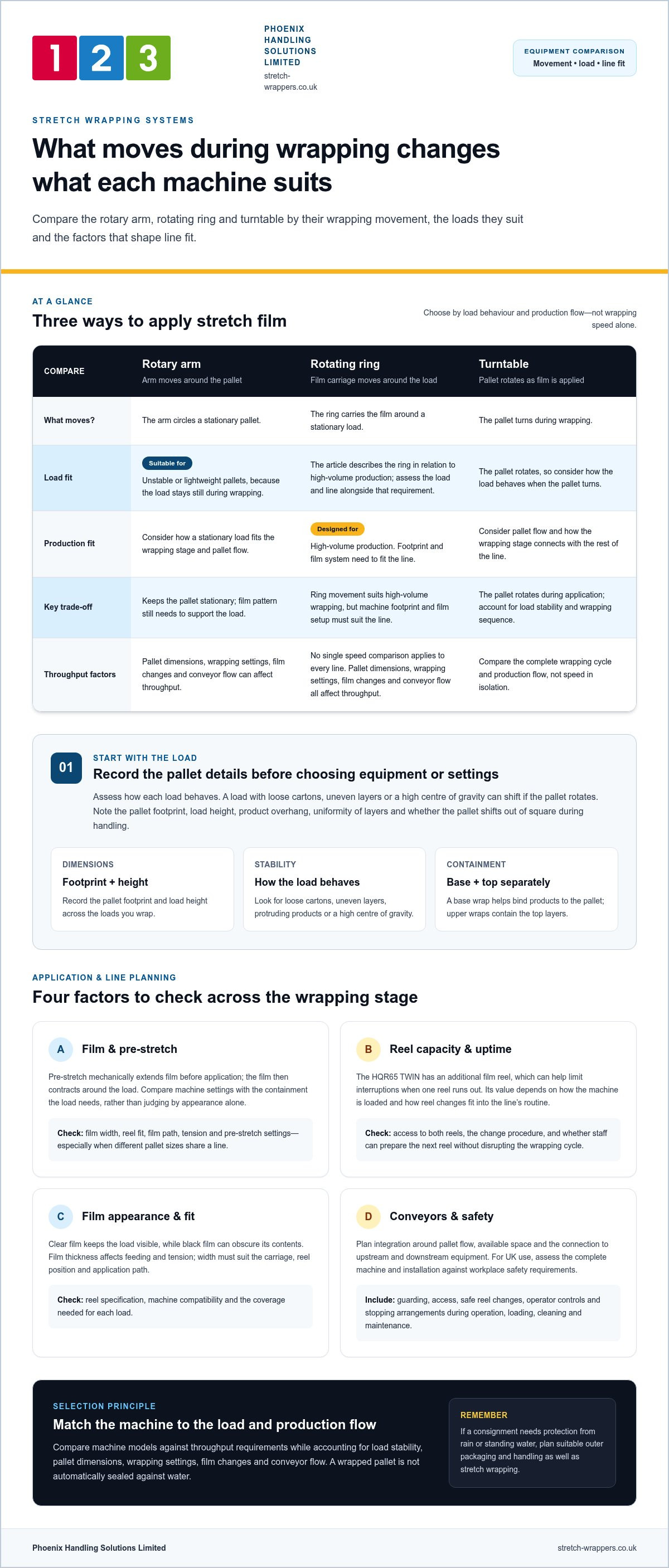
The fastest wrapping option isn’t automatically right for every pallet. A rotary arm stretch wrapper moves its arm around a stationary load, making it suitable for unstable or lightweight pallets. A ring stretch wrapper moves the film carriage around the pallet and is designed for high-volume production. The key difference is what moves, and how that movement suits your loads and line.
It’s easy to focus on wrapping speed alone, but load stability, pallet dimensions and how pallets enter and leave the line all matter. This guide explains how rotary arm and ring machines work, which loads they suit, and what to consider when matching a wrapper to your throughput needs.
You’ll also learn how ring-wrapper models can fit into a packaging line, from the wrapping process to practical integration considerations, helping you compare options against your operation’s requirements.
Key Takeaways
- Choose between a rotating arm and ring design by considering what moves during wrapping and how that suits your line.
- Match the wrapping method to load stability: a rotating arm can wrap a stationary pallet, making it suitable for unstable or lightweight loads.
- Assess your product mix and packaging needs to determine where automatic stretch wrapping could fit across different industries.
- Plan conveyor and line integration around pallet flow, space, and how the wrapping stage connects with upstream and downstream equipment.
- Compare machine models against your throughput requirements, while accounting for the pace and consistency your production line needs.
What's the difference between a rotary arm and rotating ring stretch wrapper?
A rotary arm turns around a stationary pallet; a ring machine moves its film carriage around the load. This difference affects film application, line layout and the loads each machine can handle.
Pre-stretch and film consumption
Pre-stretch mechanically extends film before it is applied to the pallet. The film then contracts around the load, helping hold it together. To assess film consumption, compare the machine’s settings with the containment the load needs, rather than judging the wrap by appearance alone.
Film width and machine compatibility must be considered together. A bespoke width needs to suit the film carriage, reel position and application path so the film feeds and wraps consistently. Check how the selected width works with the machine’s tension and pre-stretch settings, especially when different pallet sizes share a line.
Additional reel capacity and uptime
The HQR65 TWIN has an additional film reel, which can help limit interruptions when one reel runs out. Its value depends on how the machine is loaded and how reel changes fit into the line’s routine. Consider access to both reels, the film-change procedure and whether staff can prepare the next reel without disrupting the wrapping cycle.
Uptime also depends on using film suited to the machine’s feed and application settings. A reel with the wrong width or thickness can affect threading, tension and wrap consistency. Matching the reel specification to the machine helps make its capacity useful in day-to-day production.
Film application and wrapper speed
A ring carries the film around a pallet, while a rotary arm circles a stationary load. A turntable wrapper rotates the pallet as film is applied. Ring designs suit high-volume production, but no single speed comparison applies to every line. Pallet dimensions, wrapping settings, film changes and conveyor flow all affect throughput.
Film colour and thickness are practical selection points, not just cosmetic details. Clear film keeps the load visible, while black film can obscure its contents. The film must also suit the machine’s carriage and settings, as thickness affects feeding and tension. For bespoke widths, check reel fit, the film path and the coverage needed for each load.
Safety requirements and wrapper trade-offs
For UK use, assess the complete machine and installation against the safety requirements that apply to the workplace. Consider guarding around the moving ring or arm, access to the wrapping area, safe reel changes, operator controls and stopping arrangements. The assessment should cover normal operation, loading, cleaning and maintenance, not just the wrapper in isolation.
A ring machine suits high-volume wrapping, with its film carriage moving around the pallet. Its footprint and film system need to fit the line. A rotary arm keeps the pallet stationary, suiting unstable or lightweight loads; a turntable rotates the pallet during wrapping. Choose according to the load and production flow.
Wrapping stable and unstable pallet loads
Load stability, pallet dimensions and the wrapping sequence all affect containment. Start by assessing how each load behaves before choosing equipment or settings.
Pallet dimensions and load stability
A rotary arm turns around a stationary pallet, making it suitable for unstable or lightweight loads. A load with loose cartons, uneven layers or a high centre of gravity can shift if the pallet itself rotates. Keeping it still during wrapping helps avoid that movement, although the film pattern must still support the load.
Record the pallet footprint, load height and product overhang across the loads you wrap. A short, wide pallet of light cartons, for example, presents different stability concerns from a tall load with a narrow base. Note whether layers are uniform, products protrude, or the pallet shifts out of square during handling. These observations help match the machine and wrap settings to actual loads.
Standard pallet wrapping cycles
An automatic cycle typically starts with the pallet positioned in the wrapping area and the film attached to the load. The machine applies film around the base, travels up the load and finishes with a top or finishing wrap before cutting the film. The exact sequence depends on the machine and selected programme.
Assess the bottom and top separately. A base wrap helps bind products to the pallet, while upper wraps contain the top layers. For mixed pallets, a consistent cycle may need different settings to suit load height or shape. Check finished loads for loose corners, shifting layers and exposed sections, then adjust the wrap pattern accordingly.
Stretch film can help hold a pallet together, but wrapping alone may not provide complete protection from water. Film coverage, seams and contact with the pallet affect how well the load resists moisture. If a consignment needs protection from rain or standing water, plan suitable outer packaging and handling as well as stretch wrapping. A wrapped pallet is not automatically sealed against water.
For orders of pallet-wrapping equipment, define the number of lines, machine configuration and installation needs early. These factors shape procurement and lead-time planning: a straightforward specification differs from an order requiring line integration or commissioning. Production scheduling and delivery arrangements also affect the sequence, so align those details with the planned changeover instead of assuming every order follows the same timeline.
Where several load types share a line, compare the full range of pallet dimensions and stability before selecting pallet wrapping equipment. That gives the wrapping cycle a practical starting point, rather than relying on one representative pallet.
Industries using automatic stretch wrappers
Automatic stretch wrapping suits operations that prepare repeat pallet loads for storage or dispatch. Food and drink manufacturers, for example, may wrap cases of bottled products, while household-goods producers may secure cartons before warehouse handling. The key question is whether the pallet formats, product mix and production flow suit an automatic cycle, not simply which industry uses a wrapper.
In manufacturing, a wrapper can handle recurring loads of boxed components, finished goods or bagged products. A factory sending similar pallets through a packing line can use a defined wrap pattern; mixed production may need settings for different load heights and shapes. A pallet of uniform cartons, for example, presents a different wrapping task from one carrying boxes of varying sizes.
Timber and building-products businesses also handle long products that need a different approach from conventional pallet wrapping. Pipes, tubes, profiles, lumber, doors, windows, boards and textile rolls are examples of goods suited to horizontal orbital stretch wrapping. This method carries film around an individual long item rather than rotating a pallet load, so the product’s length, width and support points guide equipment selection.
Furniture and industrial-profile manufacturers can use spiral wrapping for individual long goods such as furniture, plastic tubing and large profiles. Horizontal orbital wrapping can help protect packages from dust, moisture and damage during handling and storage. The over-wrapping rate can be adjusted to package width, making product width an important setting to consider alongside surface and shape.
Warehouse and distribution operations often handle goods from several industries, making pallet variety the main consideration. A dispatch line might process packaged food, furniture cartons and building supplies. Before choosing an automatic system, group products by pallet footprint, load height, weight distribution and required film coverage. This shows whether one wrapping cycle suits the work or different load profiles need separate settings.
For long products, stretch film is not the only packaging method used across industry. Depending on the package and protection required, horizontal orbital wrapping can replace materials such as foam, tape, shrink wrapping, paper, knit belt, string and PET belt. Compare product shape, handling route and required containment to identify a suitable approach, whether the job involves palletised goods or individually wrapped items.
Integration with conveyors and packaging lines
A wrapper works best as part of a planned pallet route, not as an isolated machine. Map how pallets leave production, enter the wrapping area and move towards dispatch, noting transfers, waiting points and operator access.
Start with the infeed conveyor and pallet positioning. Loads need to arrive consistently so the wrapping cycle can begin correctly. A pallet arriving skewed from a roller conveyor, for example, may need aligning before film application. Check pallet orientation, load overhang and conveyor height, then compare them with the wrapper’s infeed arrangement.
Next, consider how the wrapper communicates with nearby equipment. A line may use sensors to detect an approaching pallet, pause upstream flow when the wrapping area is occupied and release the finished load to an outfeed conveyor. Define each hand-off, including what happens if a pallet stops or the wrapper needs attention. This helps prevent queues between palletising and dispatch.
- Infeed: Confirm pallets can transfer from the existing conveyor without snagging or turning unexpectedly.
- Positioning: Set a repeatable stopping point so each load reaches the wrapping station consistently.
- Outfeed: Allow the wrapped pallet to clear the machine before the next load enters.
- Line control: Coordinate stop and restart signals across the wrapper, conveyor and upstream palletiser.
Available floor space matters as much as conveyor direction. A ring machine needs room for its moving film carriage, while an arm wrapper needs clearance for its rotating arm. Map the machine footprint alongside walkways, access doors and nearby equipment. A tight corner between a palletiser and dispatch lane, for instance, may affect where operators load film or reach controls.
Throughput depends on the whole route, not just the wrapping cycle. If a palletiser releases loads faster than the wrapper can process them, pallets may build up on the infeed. If the outfeed is blocked, the wrapper cannot release finished loads. Review the slowest hand-off and consider whether a buffer area or different conveyor arrangement would keep the flow orderly.
Film changes, fault recovery and routine cleaning also belong in the line plan. Position reel access so staff can work without obstructing pallet movement, and ensure maintenance access does not require dismantling conveyor sections. A clear route for removing a stopped pallet can also reduce disruption when a load needs repositioning.
Before installation, trace a representative pallet from the production line to dispatch, including transfer points and changes in direction. This walkthrough can reveal clashes between conveyors, guarding, operator access and load dimensions. The resulting layout is designed around the actual packaging sequence, supporting safer movement and more efficient line operation.
Rotating ring stretch wrapper models and throughput
Choose a ring machine by matching pallet dimensions, required containment and line flow to its capabilities. For a warehouse or production line, first assess the loads and available space, then compare throughput needs with the complete wrapping and conveyor process.
Motorised ring-wrapper model identifiers include WR 1400T, WR 1050 and WR 2500M. These names identify different machines, but the identifier alone does not show which will suit your operation. Compare each model’s working capacity and configuration against your pallet range, film requirements and the way loads reach the wrapping station.
A rotating ring carries the film carriage around the pallet, making this design suitable for high-volume production requiring high throughput. The ring’s movement can support a continuous flow of loads, but the wrapping cycle is only one part of output. Pallet arrival, positioning, film application, discharge and downstream clearance all affect how smoothly the line runs.
Build a realistic throughput assessment from the actual operating sequence. Record the pallet formats that pass through the line, how often each appears and whether loads need different wrapping patterns. Then map the route from palletising to dispatch. If a conveyor cannot clear a wrapped load promptly, the next pallet may wait, regardless of the ring’s wrapping capability.
Use these checks to compare models and line requirements:
- Load range: Compare pallet dimensions and load profiles with the machine’s working capacity.
- Containment: Define the film coverage and wrap pattern required for representative loads.
- Flow: Review infeed, positioning and outfeed alongside the wrapper cycle.
- Changeovers: Consider how film replenishment and shifts between pallet formats affect production flow.
A line handling one consistent pallet format, for example, operates differently from a warehouse switching between several load profiles. The second operation needs to account for changes in positioning and wrapping settings, as well as the time needed to manage each format. Comparing these real tasks helps avoid choosing on model name or headline speed alone.
To assess a ring wrapper against your line, prepare representative pallet dimensions, load examples and the route from infeed to dispatch. You can discuss ring wrapper requirements in terms of throughput, film application and integration, keeping the decision grounded in how your operation runs.
Phoenix Handling Solutions Limited: Rotating turntable stretch wrappers
Phoenix Handling Solutions Limited supplies rotating turntable, rotating arm and ring stretch wrappers, helping you compare machine movement with pallet stability, line layout and throughput needs. A turntable may suit a line where rotating the pallet fits the wrapping process; an arm or ring design offers alternatives for different loads and production requirements.
Once you’ve selected a suitable machine, Phoenix can provide installation, commissioning and training to support its introduction into your operation. This is a practical next step when planning a new wrapping station or integrating equipment into an existing packaging line.
To discuss your pallet-wrapping requirements, contact Phoenix Handling Solutions Limited or visit stretch-wrappers.co.uk.
Plan your next wrapping-line decision
Your next step is to compare the wrapping requirement with the wider job the line must do. A ring stretch wrapper should suit your pallet mix and operating flow, not just an ambitious throughput target. Use representative loads and trace their route through your facility to guide the decision, then consider how the wrapping station will serve future production needs.
Phoenix Handling Solutions Limited offers rotating turntable, rotating arm and ring stretch wrappers, giving you options to discuss for your application. If you’re reviewing a new line or replacing existing equipment, consider how a ring stretch wrapper will handle your loads and fit into the wider packaging process.
Explore wrapping options with Phoenix Handling Solutions Limited and take the next step towards a setup that suits your operation.
Frequently Asked Questions
What is a ring stretch wrapper and how does it work?
A ring stretch wrapper secures palletised goods by carrying a film carriage around the load. The film is applied in overlapping passes, with the wrap pattern set to contain products and hold them together for handling. A pallet of cartons, for example, may need a different number of passes around its base and upper layers. Film tension and pre-stretch settings affect how the film feeds and grips.
What types of ring stretch wrappers are available?
Ring models come in different configurations, selected according to load dimensions, film requirements and line arrangement. Motorised Pack Ring Wrapping System models include WR 1400T, WR 1050 and WR 2500M. These identifiers alone don’t determine suitability: compare each machine’s specifications with the pallets and operating conditions it needs to handle, including how loads enter and leave the wrapping station.
What loads and pallet sizes can a ring stretch wrapper handle?
A ring stretch wrapper handles pallet loads that fit the selected machine’s working range and can be positioned consistently. Suitability depends on pallet width and length, load height, overhang and product arrangement. A tall, narrow stack, for instance, needs a different containment assessment from a low, broad pallet. Compare representative load dimensions and shapes with the machine configuration before selecting it.
What are the running costs and film savings of a ring stretch wrapper?
Running costs depend on film consumption, energy use, servicing and replacement parts. Pre-stretch extends film before application, so consumption depends on machine settings and the containment each load requires; savings are not a fixed outcome. Equipment price depends on configuration, line integration and installation requirements, and is provided after a quote request. Comparing film use across consistent loads gives a practical basis for assessing operating costs.
What safety requirements and UK regulations apply to ring stretch wrappers?
Assess the complete machine and installation against the safety requirements that apply to the workplace. Consider guarding, access to the wrapping area, safe reel changes, operator controls and stopping arrangements during operation, loading, cleaning and maintenance.
How to install and maintain a ring stretch wrapper?
Plan installation around pallet flow, available space and connections to upstream and downstream equipment. Include safe access for cleaning and maintenance, and consider guarding, reel changes, controls and stopping arrangements.
How fast is a ring stretch wrapper compared with a turntable wrapper?
Ring wrappers suit high-volume production, but throughput compared with a turntable wrapper depends on pallet dimensions, wrapping settings, film changes and conveyor flow.


