

Automation isn’t only for neat, identical pallets. A fully automatic wrapping line can secure high volumes of palletised goods, including loads with varying dimensions or awkward shapes. It can detect a load, apply film, run a programmed wrapping cycle and cut the film without manual input, helping prepare goods for storage and transit while protecting them from dust and moisture.
As order volumes rise, hand wrapping can become harder to keep consistent, while repeated handling takes time and effort. Automated systems bring wrapping into a more continuous flow, with conveyors moving pallets through the line and sensors supporting accurate film placement.
This guide explains what these lines can wrap, how the process works and which machine type may suit different loads. It covers turntable, rotating arm and ring wrappers, then the practical factors that shape a system, from load stability and throughput to the equipment around the wrapper. This will help you assess how a wrapping line could fit into pallet operations and what to consider when planning one.
Key Takeaways
- Match the wrapping setup to pallet height, load shape and stability so film is applied where it supports the load effectively.
- Consider how goods move through production, storage and dispatch when deciding where automated wrapping fits into your operation.
- Compare turntable, rotating arm and ring wrappers by load behaviour and required throughput, rather than choosing on speed alone.
- Follow the process from pallet entry through wrapping, film cutting and labelling to see which stages can be automated.
- Explore installation, commissioning and training alongside machine selection to help integrate a suitable wrapper into your pallet operations.
What is Automated Pallet Wrapping?
Automated pallet wrapping combines a wrapping machine with equipment such as conveyors, weighing systems and labelling systems. A fully automatic wrapping line can detect a load, apply film, run a programmed cycle and cut the film without manual input.
Handling Different Pallet Loads
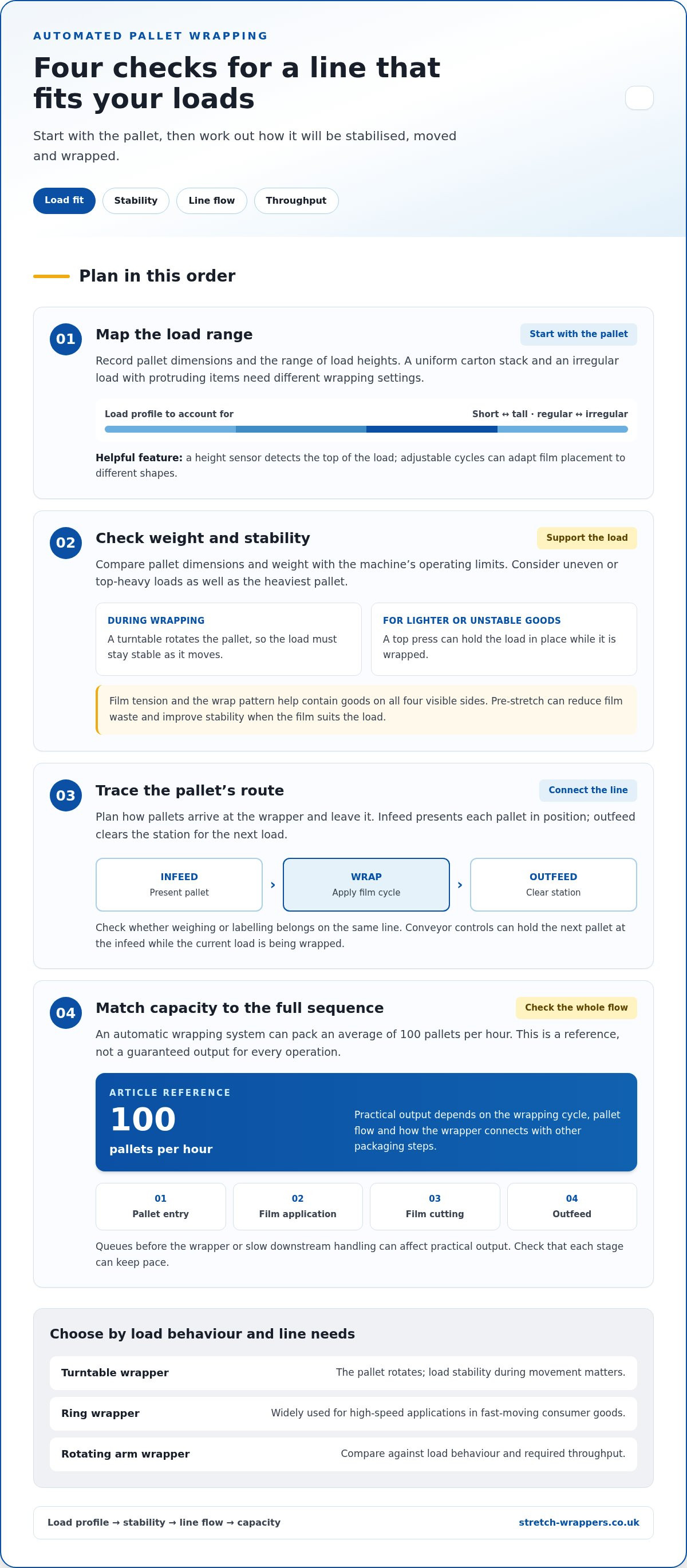
Wrapping pallets of different heights and shapes depends on the load profile and machine settings. A height sensor detects the top of a pallet load, helping position film accurately around short, tall or mixed-height consignments. Adjustable wrap cycles can also accommodate different load shapes, so film placement suits the goods rather than following one fixed pattern.
Before selecting a system, record pallet dimensions and the range of load heights moving through the line. A uniform stack of cartons, for example, presents different wrapping demands from an irregular pallet with protruding items. Pre-stretch systems stretch film before application, which can reduce waste and improve load stability when the film suits the load.
Conveyor Integration and Load Sensing
Infeed and outfeed conveyors move pallets into and away from the wrapping station, linking pallet wrapping to the wider packaging and logistics flow. The infeed needs to present each pallet in the correct position; the outfeed clears the station for the next load. This reduces the need to move pallets manually between separate process steps.
Load-height sensors detect each pallet’s height and support accurate film placement. The sensor reading can inform the wrapping cycle, helping avoid unnecessary film above or below the load. When planning conveyor integration, consider where pallets arrive, how they leave and whether weighing or labelling needs to happen along the same line.
Load Capacity and Stabilisation
Check pallet dimensions and weight capacity against the machine’s operating limits, as both affect how a load enters and moves through the wrapping station. The heaviest pallet is not the only consideration: an uneven or top-heavy load can behave differently from a compact, evenly stacked one. These details influence the support, cycle and film tension required.
Pallet grip and load containment matter too. A turntable rotates the pallet, so the load must remain stable during movement; a top press can hold light or unstable goods in place while wrapping. Film tension and the wrap pattern help secure items on all four visible sides, while a suitable cycle limits movement during storage and transit.
Production Speed and Capacity
An automatic wrapping system can pack an average of 100 pallets per hour. Actual line capacity depends on the wrapping cycle, pallet flow and how the wrapper connects with other packaging steps, so the average is a reference rather than a guaranteed output for every operation.
Compare the required throughput with the full sequence, including pallet entry, film application, cutting and outfeed. If pallets queue before the wrapper or downstream handling cannot clear wrapped loads, the line’s practical output will be affected. Planning for each step helps align machine capacity with production demands and the movement of goods through logistics.
Industries using automated pallet wrapping
Automated pallet wrapping suits operations that repeatedly move palletised goods between production, storage and dispatch. Its value depends on the product, load pattern and how the wrapping station fits into the existing flow. Ring wrappers, for example, are widely used for high-speed applications in fast-moving consumer goods. Ceramic packaging can combine horizontal strapping, wrapping and stretch hooding in one connected sequence.
Different industries use wrapping to prepare loads for handling and transit. Food and household goods often leave production in regular pallet loads, while building products may create heavier or less uniform stacks. In each case, consider the load’s shape, stability and destination before setting the wrapping cycle. Loads passing through several logistics stages need containment suited to their handling, not simply a fast cycle.
A fully automatic process can connect palletising robots to the wrapping station, reducing separate manual transfers. The robot builds a pallet, then transfers it towards wrapping along a conveyor route. Clear handover points matter: pallets must arrive in a consistent position, and the wrapping cycle needs to suit the completed load. This integration can help keep goods moving through successive packaging steps.
Automated guided vehicles (AGVs) and autonomous mobile robots (AMRs) can transport pallets between production lines, storage areas, wrapping stations and loading bays. Their routes should connect to the line’s entry and exit points, with enough space for safe pallet presentation and collection. Mapping these movements helps identify where vehicles wait, where pallets queue and how wrapped loads reach dispatch.
Powered-roller conveyors can present pallets to a wrapping station and carry them onwards after the cycle. Rollers define the direction of travel, while conveyor controls coordinate pallet movement with the wrapper. For example, a line can hold the next pallet at the infeed while the current load is wrapped, then release it when the station is clear. This can improve flow without adding unnecessary handling steps.
Common problems include film breakage and machine downtime. Film specifications that do not suit the machine, or a machine that needs calibration, can interrupt operation. Matching film to machine capability and regular calibration help address these issues.
Which UK suppliers offer automatic wrapping lines and after-sales support? Specialist UK packaging machinery suppliers provide pallet wrapping equipment, with support options such as installation, servicing, spare parts or service contracts varying by supplier. Compare the complete support scope alongside the machine and its integration needs, rather than judging suitability on wrapping speed alone.
Automatic and semi-automatic wrapping machine types
The wrapper determines how a pallet is supported and how film moves around its load. Choosing between automatic and semi-automatic machines starts with pallet stability, required throughput and the handling equipment already available around the line.
A fully automatic wrapping line can include infeed and outfeed conveyors, a wrapping machine, and weighing or labelling systems. The wrapper applies film; connected equipment brings pallets to the station and prepares them for the next packaging step. A strapping machine can also be used earlier in the process when loads need compacting before wrapping.
Turntable, rotating arm and ring wrappers suit different operating conditions:
- Turntable wrappers: the pallet rotates on a platform as film is applied. They suit stable, uniform loads and moderate throughput.
- Rotating arm wrappers: the pallet stays still whilst the arm rotates around it. This arrangement suits heavy or unstable loads that are less suitable for rotation.
- Ring wrappers: the film carriage travels around the load, making this design suitable for high-speed applications, including FMCG operations.
Ring machines can control the height at which film and cord are applied. Automatic models can wrap upwards, downwards or in both directions, allowing the cycle to be tailored to the load. Compare these functions with actual pallet profiles and line requirements, rather than treating all advanced machines as interchangeable.
Semi-automatic wrappers require an operator to carry out parts of the process, such as attaching film or starting the cycle. They can suit a lower-volume station where pallets are brought to the wrapper individually. Automatic machines handle more of the sequence, using conveyor-fed entry and programmed cycles, so operators have less direct involvement with each load. The right level of automation depends on pallet flow and the work available around the station.
For UK machinery, safety planning should cover risk assessment, guarding, interlocked access, emergency stops and safe isolation. Apply relevant machinery and workplace safety requirements to the complete installed line, including conveyors and access points, rather than considering the wrapping machine alone.
Which machines form the main line? Typically, conveyors move pallets through a wrapping machine, with weighing and labelling equipment added where the process requires them. The arrangement depends on whether the priority is stable presentation, load restraint or higher throughput.
Compare machine performance with the load, available floor space and labour involved in pallet handling. A rotating turntable wrapper may suit a steady flow of uniform pallets, while a stationary pallet position can be preferable for loads that should not rotate. Machine servicing and service contracts support planned upkeep, helping keep the equipment aligned with operating demands.
Automatic wrapping system operation
A wrapping system coordinates pallet entry, load detection, film application and discharge through connected controls. Installation planning should allow space for the wrapper, conveyors, operator access, and the electrical and control connections required by the selected equipment.
End-of-Line Operations
At the end of the line, the wrapped pallet moves towards dispatch, storage or another packaging stage. A typical sequence runs from wrapping to automatic film cutting and sealing, followed by label application where labelling equipment is integrated. Shipping labels can be applied at the final stage, so their position and timing should suit the next handling step.
Plan the outfeed around how goods leave the area. A pallet collected by a forklift, for example, needs a clear route from the conveyor, while a line feeding an automated warehouse needs a compatible handover point. These connections help create a smooth process from wrapping through onward logistics.
Continuous Operation
Continuous operation relies on each section passing pallets forward at a workable pace. Infeed conveyors present loads, the wrapping machine completes its programmed cycle, and outfeed equipment clears the station. If downstream handling cannot accept wrapped pallets, they can queue and interrupt the flow, even when the wrapper is ready.
Map where pallets wait, where operators replenish film and how completed loads are removed. Planned pauses for film changes or routine checks also affect how the line runs across a shift. Allowing for these tasks in the operating sequence helps teams organise production without assuming uninterrupted running.
The cycle begins when a pallet enters the wrapping station. Sensors detect load height, then the control system selects the programmed wrap cycle and manages film application. The machine applies stretch film at controlled tension, following the cycle set for that load. Automatic cutting and sealing can finish the wrapping stage without manual film handling.
Line controls also coordinate the wrapper with connected equipment. An upstream palletising robot, for instance, can signal that a load is ready, while a downstream conveyor confirms that the previous pallet has cleared. This exchange helps prevent pallets entering a busy station or waiting there unnecessarily.
Installation needs depend on the selected machine and its position within the building. The layout must accommodate pallet dimensions, conveyor routes, safe access for operation and maintenance, and space for film handling. Electrical supply and control connections must suit the equipment. Plan these alongside production flow, not as afterthoughts.
Commissioning puts the planned sequence into practice: test pallet movement, set the wrap cycle, check film application and run representative loads through the full route. Operator training then covers the controls, normal running and routine operating tasks. A stretch hooder may suit a line that requires a different form of pallet covering, so the chosen end-of-line equipment should match the load and dispatch process.
Fully automated wrapping process
A fully automatic wrapping line links pallet movement, film application and finishing in a programmed sequence. Its practical value comes from coordinating each step, allowing production to move goods through wrapping with less manual intervention. The process still depends on suitable film, stable loads and settings matched to the machine.
A typical cycle follows these stages:
- Present the pallet. An infeed conveyor delivers the load to the wrapping station, where sensors detect its position and height.
- Secure the film. The machine attaches film automatically, then applies it around the load using the selected wrap cycle and controlled tension.
- Complete the wrap. The system cuts and seals the film, removing the need for manual finishing at this stage.
- Move the load onward. An outfeed conveyor carries the wrapped pallet towards labelling, storage or dispatch.
Each stage needs to work with the next. If a pallet arrives out of position, the wrapper may not apply film as intended; if the outfeed cannot clear the finished load, the next cycle may have to wait. Sensors, conveyor controls and programmed settings therefore need to be planned as one process, rather than as separate machine functions.
Film choice affects the result too. Select material for stretch capability, load retention, consistent gauge and puncture resistance. Matching film specifications to the machine’s capabilities can help prevent breakage, while regular calibration supports consistent operation. Pre-stretch systems stretch film before application, which can reduce material waste and improve load stability when the film suits the load.
Automation can also reduce the need for employees to walk around pallets, bend repeatedly or handle heavy film rolls. This changes the work around the station: operators can focus on monitoring the process and replenishing film instead of manually wrapping each load. Automatic cutting and sealing further reduce hands-on finishing, although film replenishment and routine checks remain part of operating the line.
Where a system includes labelling equipment, shipping labels can be applied at the final wrapping stage. Warehouse management system integration can coordinate wrapping data with inventory and dispatch schedules, helping connect production to the next logistics step. Sensor-based tension adjustment and data-led film-use optimisation can also support more controlled material use across different loads.
For a line built around stretch-film application, explore stretch wrapper options as part of your equipment planning.
Phoenix Handling Solutions Limited: Rotating turntable stretch wrappers
Phoenix Handling Solutions Limited supplies rotating turntable stretch wrappers for stable, uniform pallet loads, alongside rotating arm and ring wrappers for different load behaviours and throughput requirements. Comparing pallet stability, dimensions and position in the production flow helps identify which machine type fits the operation.
For a new installation or a change to an existing pallet-wrapping setup, Phoenix Handling Solutions Limited provides installation, commissioning and training. This support brings the equipment into operation and familiarises operators with its controls and working process. The next step is to discuss your pallet loads and line requirements with the team. Contact Phoenix Handling Solutions Limited to talk through your wrapping needs.
Plan the next step for your pallet operation
Before planning a fully automatic wrapping line, turn your operational requirements into a practical equipment brief. Note the loads to be wrapped, the available space, how pallets enter and leave the station, and the level of automation your team needs. These details help shape a line around your production flow, rather than adding equipment without a clear role.
Phoenix Handling Solutions Limited offers rotating turntable, rotating arm and ring stretch wrappers, with installation, commissioning and training. Discuss your loads and line requirements with the team to identify an approach for a fully automatic wrapping line.
Contact Phoenix Handling Solutions Limited to discuss your pallet-wrapping requirements and explore a practical way forward.
Frequently Asked Questions
What can it be used for?
Automated pallet wrapping secures palletised goods for storage, handling and transit. It can suit regular carton stacks, mixed-height consignments and awkwardly shaped loads, provided the wrapping cycle matches their stability and dimensions. A distribution operation, for example, can wrap completed pallets before dispatch, while a manufacturer can connect wrapping to production. Consider how the load will be handled next to determine the containment needed.
What kind of wrapping machine do I need for my product?
Choose a wrapper based on load behaviour, pallet handling and required production flow. A turntable suits stable, uniform pallets; a rotating arm keeps heavier or unstable loads stationary; a ring wrapper is designed for high-speed applications. For a fragile stack, consider how the machine supports the pallet during wrapping. Comparing representative loads and dimensions makes the choice more practical than selecting by machine type alone.
What is a fully automatic wrapping line?
A fully automatic wrapping line connects equipment to move palletised goods through wrapping with minimal manual input. It may combine conveyors, a wrapper and weighing or labelling systems. A pallet can arrive from production, pass through a programmed cycle, then continue towards dispatch. Plan the line as a sequence, ensuring the equipment before and after wrapping suits pallet flow and the next handling task.
What products and packaging materials can a fully automatic wrapping line handle?
A fully automatic wrapping line can handle palletised products whose dimensions, weight and stability suit the equipment, including carton stacks and irregular loads. Stretch film is applied around the pallet, and its stretch capability, load retention, gauge consistency and puncture resistance affect performance. Strapping, shrink wrapping and stretch hooding use different machinery and processes, not interchangeable film choices. Match the packaging method to the product and its handling route.
How does a fully automatic wrapping line compare with a semi-automatic line?
A fully automatic wrapping line handles more of the pallet movement and wrapping sequence, while a semi-automatic machine requires an operator to complete some steps. A semi-automatic setup may suit a work area where pallets arrive individually and an operator attaches film or starts each cycle. Automation reduces repeated wrapping tasks, but its value depends on whether connected equipment can keep pallets moving.
How do you choose the right automatic wrapping line for a business?
Start by mapping the loads, pallet flow and destination of wrapped goods. Record pallet sizes, load stability and required output, then assess conveyor access, floor layout and any labelling or weighing steps. A fully automatic wrapping line needs to fit both the product and the surrounding operation. Phoenix Handling Solutions Limited supplies turntable, rotating arm and ring stretch wrappers, with installation, commissioning and training for supplied equipment.
What maintenance, operating costs, and staffing does an automatic wrapping line require?
Routine upkeep, film use, energy, spare parts and production interruptions all affect operating costs; the machine and its workload shape the balance. Operators still monitor the line, replenish film and carry out routine checks, although automatic cycles reduce manual wrapping tasks. Planned servicing supports ongoing machine operation. Phoenix Handling Solutions Limited offers machine servicing, service contracts and spare parts, alongside operator training for supplied equipment.


