

Hand wrapping can secure a pallet, but it takes time and may use more film than a machine-led process. Stretch wrap automation can help make wrapping more consistent, reduce film waste and improve load stability. Automatic machines can detect a pallet, apply film, complete the cycle and cut the film without manual finishing.
It’s understandable to weigh the investment and workflow changes against the time saved at the wrapping line. The right choice depends on pallet volumes, load type and stability, and how much operator involvement you want to retain.
This guide compares semi-automatic and fully automatic pallet wrappers, explains how machine-applied film helps secure loads, and outlines the practical trade-offs. You’ll also learn how engineering support can help when planning automated wrapping, so you can assess the options against your site’s needs.
Key Takeaways
- Pre-stretching can make better use of film and help maintain load stability, so consider how the wrapper controls film tension.
- Match the machine to your daily pallet volume and load type: semi-automatic equipment keeps an operator involved, whilst automatic systems can feed, wrap and discharge pallets.
- Assess the whole wrapping process, including pallet movement, operator tasks and how the machine will fit into your production or dispatch flow.
- Consistent wrapping depends on more than film coverage; load shape, stability and the wrapping pattern all affect how securely goods travel.
- Compare the benefits of automation with its practical limitations, then consider which wrapper design and engineering support best suit your operation.
Why automate pallet wrapping?
Automation can make wrapping more consistent, while pre-stretching helps use each roll more efficiently. Settings matter: film tension, load shape and the stability required all affect the result.
For UK operations, assess automated wrappers against applicable machinery and workplace safety requirements. Consider guarding, safe access, emergency stops, isolation during maintenance, operator training and a site-specific risk assessment. These controls help identify hazards around moving parts, rotating loads and film handling.
Film pre-stretching and roll usage
A pre-stretch system stretches film before it reaches the pallet, extending the film and helping improve roll usage. The mechanism matters: automatic stretch wrapping machines commonly use two film-thread rollers, with the second rotating faster than the first.
When assessing this feature, consider how the wrapper controls film tension and applies film to different load profiles. Too little tension can leave a loose wrap; too much can distort products or shift unstable items. Compare finished-load stability, film coverage and roll use across representative pallets.
Future growth also affects the decision. A wrapping line designed for today’s output may become a constraint as production or dispatch volumes rise. Map how pallets move from production to storage and loading, then consider whether the process can accommodate higher throughput or connect with conveyors. This helps distinguish useful capacity from equipment that exceeds current needs.
Film optimisation and waste reduction
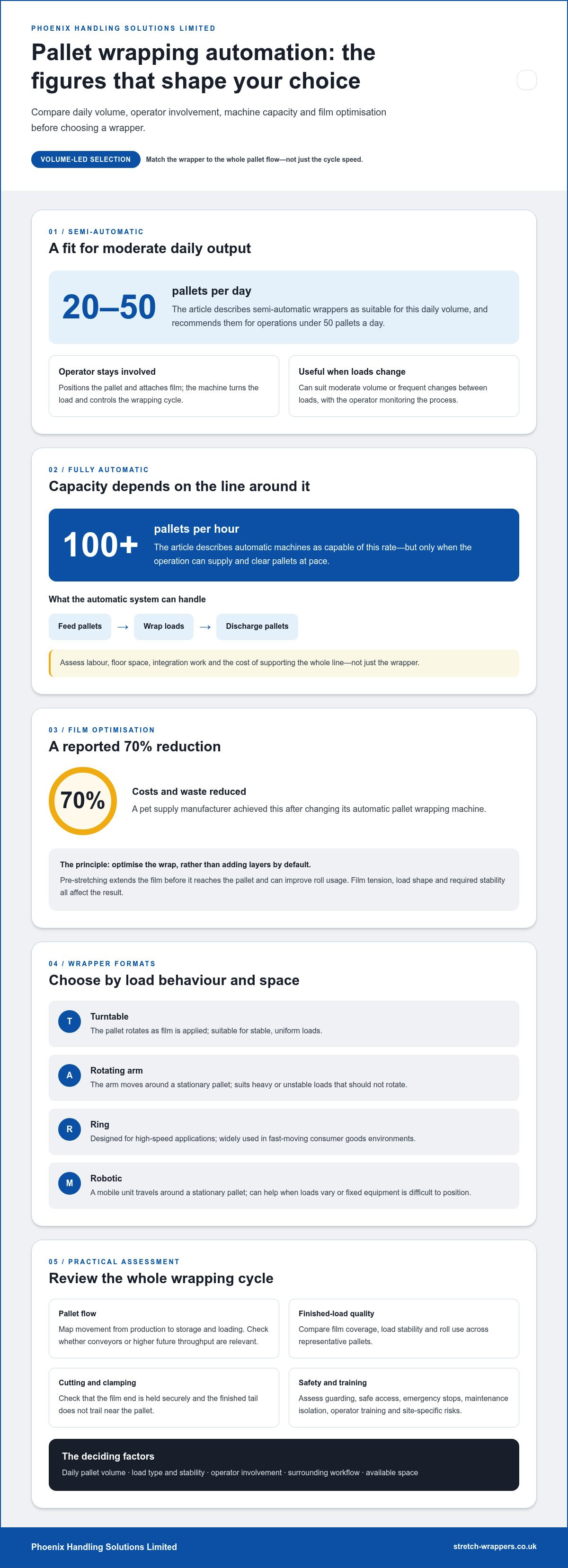
Film optimisation focuses on matching the wrapping pattern and tension to the load, rather than applying extra layers by default. Review film consumption alongside load stability, product protection and the consistency of finished pallets. A pet supply manufacturer reduced costs and waste by 70% after changing its automatic pallet wrapping machine, showing how machine selection can affect material use.
A practical review can compare representative loads, record the film settings used and inspect how securely each pallet travels. Look for loose tails, damaged corners and excess film around the base, then adjust the wrapping process and reassess. This makes film-use efficiency a measurable operating consideration, rather than simply a choice to use less material.
Automatic film cutting and clamping
Automatic cutting and clamping secure the film end and cut the film, removing the need for an operator to finish these steps manually. This can reduce hand-finishing between pallets and make the end of each wrapping cycle more consistent.
Assess how the clamp holds the film at the start of a cycle and how the cutter leaves the finished tail. A loose end can unravel during handling, while a poor cut can leave film trailing near the pallet. Include these details in a sample-load review, alongside film tension, coverage and load stability, before settling on a wrapping process.
Semi-automatic and fully automatic pallet wrappers
The choice depends on pallet volume, load characteristics and the level of operator involvement that suits your warehouse. Semi-automatic machines retain key manual steps, while automatic systems can connect wrapping with pallet movement.
Use daily output as a starting point, then consider the full cycle: positioning, film attachment, wrapping and discharge. A machine’s rated speed is useful only if the surrounding workflow can keep pallets moving.
Automated wrapping compared with hand wrapping
Hand wrapping requires an operator to walk around each pallet, apply film and finish the tail. A semi-automatic wrapper turns the pallet and controls the wrapping cycle after an operator positions the load and attaches the film, while the operator monitors the process.
Automation can make wrapping more consistent between operators and reduce repeated manual handling. Compare time spent on each task, film application and finished-load quality, rather than judging only by the machine cycle. For example, a team wrapping varied pallet shapes may still need to position and inspect each load carefully.
Choosing by workforce and budget
Semi-automatic machines are described as suitable for businesses wrapping 20-50 pallets per day, and a guide recommends them for operations under 50 pallets daily. They keep an operator involved, which can suit a warehouse with moderate volume or frequent changes between loads.
Automatic machines can feed, wrap and discharge pallets using a conveyor system, with little to no manual labour. They’re described as capable of wrapping 100+ pallets per hour, but that capacity depends on an operation able to supply and clear pallets at pace. Compare labour requirements, available floor space, integration work and the cost of supporting the whole line, not just the wrapper.
Wrapper types and industries
Turntable wrappers rotate the pallet as film is applied, making them suitable for stable, uniform loads. A rotating-arm wrapper moves the arm around a stationary pallet, which suits heavy or unstable loads that should not rotate. Ring wrappers are designed for high-speed applications and are widely used in fast-moving consumer goods (FMCG) environments.
Robotic wrappers use a mobile wrapping unit that travels around a stationary pallet, which can help where loads vary or fixed equipment is difficult to position. Compare the pallet footprint, load stability and space around the wrapping point before choosing a format. Pharmaceutical operations may also use scanners or vision systems to verify load contents and support traceability.
Industry is only one consideration. Food and consumer-goods dispatch, pharmaceutical distribution and general warehousing can all have different load shapes, output patterns and traceability needs. Match the wrapper to the actual pallet and production flow, rather than choosing by sector label alone.
For a practical comparison of pallet wrapper types, consider which format fits your loads and workflow, then weigh that against expected volume and operator involvement.
Packaging automation advice and engineering support
End-of-line planning connects production, packaging and dispatch, so assess the full pallet journey before choosing equipment. A wrapper should fit the existing packaging process and the pace of movement from the line to the loading area.
Installation typically involves mapping the pallet route, preparing the site, positioning and connecting the wrapper, then commissioning it with representative loads. Integration also includes operator training and checking that upstream production and downstream handling work with the wrapping cycle.
End-of-line operations and faster packaging
At the end of a production line, automatic pallet wrapping can sit between product packing and warehouse dispatch. Review each handover: how pallets arrive, where they queue, how they enter the wrapper and how wrapped loads leave for storage or transport.
Faster packaging depends on the whole line, not just the wrapper’s cycle. For example, a fast machine cannot improve output if pallets arrive irregularly or a forklift cannot clear the discharge point. Map these delays, then identify whether conveyors, a different layout or a change to the wrapping sequence could improve throughput.
Installation and line integration
Use a staged installation plan. First, record pallet dimensions, load types, line speed and available floor space. Next, position the wrapper to suit the existing production flow, allowing safe access for operators and maintenance. Then connect the machine to the line and test its controls and interfaces.
Commissioning should use representative loads, including the pallet formats and product shapes handled in normal production. Confirm that automatic pallet wrapping starts and finishes as intended, and that wrapped loads transfer cleanly to the next stage. Operator training completes the handover, covering routine operation, safe working practices and what to do when a cycle stops.
Suppliers, servicing and finance
In the UK, packaging-equipment suppliers may provide stretch wrappers alongside installation, commissioning, training and ongoing servicing. Compare engineering support with the actual line requirements, such as whether the project needs a standalone wrapper or integration with conveyors and other end-of-line equipment.
Finance arrangements vary between suppliers and finance providers, so treat equipment supply, servicing and finance as separate parts of the decision. Build a practical comparison around machine suitability, installation scope, training, parts support and service arrangements. This clarifies the overall operational commitment without confusing finance terms with engineering support.
Before selecting a supplier, prepare a brief covering pallet types, production flow, target output and site constraints. This gives an engineering team a useful basis for recommending an installation and commissioning plan. If you’re mapping options for your line, explore stretch wrapper solutions alongside your end-of-line requirements.
How stretch wrap machines secure palletised loads
Stretch wrapping holds palletised products together for storage and transit, helping protect them from damage, dust and moisture. Machines apply film around the load, with tension and coverage influencing how well the finished pallet stays contained during handling.
Pallet protection in storage and transit
In warehouse storage, machine-applied stretch film can shield products from dust and moisture. In transit, it helps keep separate items together as a pallet moves between handling points. Protection depends on the load, film coverage and handling, so review the actual route from wrapping station to delivery vehicle.
For example, a pallet with exposed cartons may need full side coverage, while a compact, uniform load may need less. Inspect the top, sides and base after wrapping, looking for uncovered areas and loose film that could catch during movement.
Load stability and pallet protection
Load stability depends on how effectively the film contains the products without crushing or shifting them. A stretch wrapping machine applies film with controlled tension, helping create a consistent wrap across each cycle. The ideal setting depends on carton strength, load shape and the position of heavier items.
Check whether the film binds the lowest products to the pallet, then inspect the load after wrapping. A tall stack of light cartons, for instance, may need a different wrapping pattern from dense, low-profile goods. Pallet wrapping machines support repeatable application, but the load itself must be arranged securely before wrapping.
Fully automatic machines apply film as part of a programmed cycle, which can reduce variation between operators and shifts. Consistency matters because loose film may allow products to move, while excessive tension can damage packaging or distort softer goods. Compare finished pallets from different product groups rather than relying on a single sample load.
For a practical check, select representative pallets from the production mix and assess them at three stages: immediately after wrapping, after warehouse handling and before dispatch. Look for shifting cartons, loosened film, exposed products or damage to outer packaging. These checks help show whether the wrapping pattern suits both the load and its journey.
Machine settings should reflect the pallet’s shape and how it will be handled. A rotating turntable wrapper turns the pallet as film is applied, whereas a rotating arm moves around a stationary load. The choice affects how the machine handles the pallet, particularly if the load is unstable or unsuitable for rotation.
Film containment also depends on careful pallet building. Keep cartons aligned, avoid unsupported overhang and distribute heavier products through the load before stretch wrapping. A well-arranged pallet gives the film a more even surface to secure, reducing the chance of weak spots during storage or transport.
Finally, treat protection as a combination of wrapping and inspection. Confirm that film reaches the pallet base, the finished tail is secure and the load remains intact after movement. This straightforward review helps teams spot changes in product shape or handling before they affect a full dispatch run.
Automatic machine advantages and limitations
Automatic wrapping machines can reduce repeated operator tasks and make pallet handling more consistent. Their value depends on whether the wider production and logistics processes can keep the machine supplied and clear finished loads.
Risks include unstable loads, incorrect film settings, machine downtime and hazards around moving equipment. Reduce them with suitable guarding, operator training, routine maintenance and checks on wrapped pallets before dispatch.
At higher output, automation can make the wrapping stage a more predictable part of the line. A fully automatic system can feed, wrap and discharge pallets, reducing manual wrapping and the hand-offs between tasks. For operations wrapping over 100 pallets, automation may be worth assessing as part of the wider production flow.
The advantage is not simply a faster cycle. Automatic pallet wrapping can standardise film application across shifts, helping supervisors compare finished loads and identify process changes. For example, a change in carton dimensions may require a revised wrapping pattern, rather than relying on each operator to adjust by feel.
There are limits. A wrapper cannot correct a poorly built pallet, and an uneven supply can leave an automatic line waiting between loads. A conveyor system also needs suitable floor space and a clear route for incoming and outgoing pallets. If product formats vary, the machine setup must accommodate those differences without slowing the line.
Downtime is another practical consideration. A fault at the wrapping station can affect surrounding processes, particularly where pallets have no alternative route. Plan maintenance access, identify who handles routine checks and consider how service support fits the operating schedule. Keeping the wrapping stage reliable is part of maintaining output.
To judge whether automation fits, map the current process from pallet arrival to dispatch. Record where operators spend time, where queues form and how often loads need rewrapping. Then compare those findings with the work an automatic system could remove, while accounting for integration, training, maintenance and available space.
Also check whether logistics can support a smooth flow. A machine may complete its cycle quickly, but the line gains little if forklifts cannot collect finished pallets or production cannot deliver the next load. A simple layout review can reveal these constraints before equipment is selected.
The clearest takeaway is to automate a repeatable, well-understood process, not a bottleneck that needs solving elsewhere. If you’re assessing wrapper options and operational fit, compare stretch wrapping machines against your line’s output, loads and handling arrangements.
Phoenix Handling Solutions Limited: Rotating turntable stretch wrappers
Phoenix Handling Solutions Limited supplies rotating turntable stretch wrappers for operations handling stable, uniform pallet loads. The turntable rotates the pallet as film is applied, so this format suits loads that can turn safely during wrapping. Consider pallet shape, stability and how the wrapper will fit into your production flow when comparing machine types.
For loads that should not rotate, a rotating-arm wrapper applies film around a stationary pallet, while ring wrappers suit high-speed applications. Phoenix Handling Solutions Limited also provides installation, commissioning and training, helping operators understand the equipment and its wrapping cycle.
If you’re weighing up wrapper formats or planning an installation, contact Phoenix Handling Solutions Limited or visit stretch-wrappers.co.uk to discuss your operation.
Plan the next step for your wrapping line
Before changing equipment, create a practical operating brief based on your line. Record pallet formats, load types, wrapping sequence and points where work slows or needs attention. This gives your team a useful baseline for assessing whether stretch wrap automation addresses a real production need, and helps define requirements for a future machine decision.
Phoenix Handling Solutions Limited offers rotating turntable, rotating-arm and ring stretch wrappers, giving you different machine formats to consider for your operation. The next step is to relate those options to how your pallets are handled, rather than choosing by output figures alone. Clear requirements can make discussions about equipment selection and line integration more focused.
If you’re ready to explore a suitable direction for your wrapping operation, contact Phoenix Handling Solutions Limited to discuss your requirements. A considered next step can help you move towards a wrapping process that fits your day-to-day work.
Frequently Asked Questions
How do you use a stretch wrap machine?
Position the pallet within the wrapping area, attach the film as directed by the machine’s operating instructions, then start the cycle. The wrapper applies film around the load, and the operator checks the finished pallet before it moves on. For example, inspect whether the film holds the bottom layer to the pallet and whether the load remains intact. Keep the wrapping area clear during operation.
What is stretch wrap automation and how does it work?
Stretch wrap automation uses machinery to carry out some or all of the pallet-wrapping cycle, rather than relying on an operator to apply film by hand. Depending on the setup, a machine can detect a load, apply stretch film, complete the cycle and cut the film. In a connected line, conveyors can also move pallets into and away from the wrapping station.
What types of automated stretch wrapping machines are available?
Common formats include turntable, rotating-arm and ring wrappers, alongside robotic wrappers that travel around a stationary pallet. Machines can also be semi-automatic or fully automatic, describing how much of the cycle requires operator involvement. These are different ways to classify equipment: turntable or rotating-arm design describes how film moves around the load, while automation level describes the process.
How do turntable, rotary arm and ring stretch wrappers compare?
A turntable rotates the pallet as film is applied, which suits stable, uniform loads. A rotary-arm wrapper keeps the pallet stationary while the arm moves around it, making it suitable for heavy or unstable loads. A ring wrapper carries film around the load using a ring mechanism and is designed for high-speed applications. Compare load behaviour, available space and required line output when choosing.
How much does an automatic stretch wrapping machine cost in the UK?
The price depends on the machine configuration and the work needed to fit it into your operation, and is given after a quote request. Relevant cost factors include the wrapper format, automation level, required throughput, site layout and integration with conveyors or other line equipment. Installation, commissioning and training may also shape the project scope. Compare the complete requirement, not just the machine purchase.
What are typical stretch film costs and usage rates for automated wrapping?
Film costs and usage depend on the roll specification, load dimensions, wrapping pattern and machine settings. A tall, uneven pallet may need a different application from a compact, uniform load. To understand usage in your operation, record how much film is used on representative pallets and assess the finished containment. Compare like-for-like loads when adjusting pre-stretch or wrap settings, so changes in film use remain meaningful.
How do I choose the right stretch wrapper for pallet size, load and throughput?
Start by recording the pallet footprint, load height, weight distribution and daily output, then identify whether pallets can rotate safely. A stable, uniform load may suit a turntable, while a heavy or unstable load may call for a rotating arm. Consider ring or robotic formats where line speed or layout is a stronger factor. Also account for pallet movement, operator tasks and space for maintenance access.


