

Your existing production line does not necessarily need replacing to bring pallet packaging into a coordinated process. An integrated pallet packaging system can combine new equipment with suitable machinery already in place, connecting palletising and wrapping with production flow and warehouse transfer. Turnkey integration into an existing line is possible, with the design shaped by product presentation, line speed, accumulation needs, changeover frequency and available floor space.
It is understandable to want a clear picture of how new equipment will fit around established processes, rather than assume the whole line must start from scratch. A well-planned project considers how each stage works with the next, taking equipment speeds, product quality, day-to-day reliability and future flexibility into account.
This guide explains how palletising and wrapping fit into a production line, which equipment and unit-load choices shape the configuration, and what a turnkey project can involve, from defining requirements and designing the line through to installation, commissioning and operator training.
Key Takeaways
- Existing equipment can remain part of a turnkey line when it suits the process, so integration starts with understanding the current layout and production needs.
- Plan the flow from packaged products through palletising and wrapping to warehouse transfer, allowing for line speed and accumulation between stages.
- Choose palletising and wrapping arrangements around the product, load pattern and handling requirements, rather than treating the wrapper as a standalone decision.
- Unit-load configuration and consumables affect how a pallet is secured for storage, handling and transport, so include them in the line design.
- Define operational objectives and performance requirements early, then coordinate equipment selection, installation, commissioning and operator training around them.
Integrating load unitisation systems with production lines
Yes, turnkey systems can integrate new packaging equipment into existing production lines. Suitable existing machinery can remain in place, with the design shaped by product presentation, line speed, accumulation needs, changeover frequency and available floor space.
Production line integration
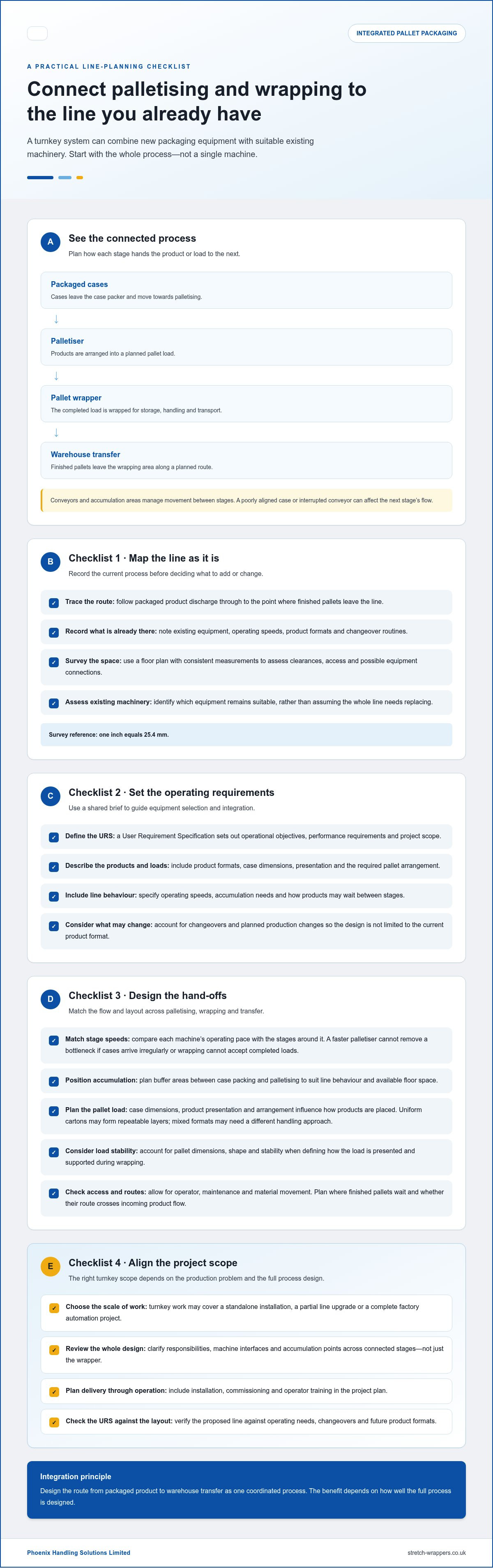
Integration connects the stages that prepare a pallet load, rather than treating each machine as an isolated island. A line might move cases from a case packer to a palletiser, then to a pallet wrapper and on to warehouse transfer. Conveyors and accumulation areas manage movement between these stages, while the layout must suit the building and product flow.
Start by mapping the current process, from packaged product discharge to the point where finished pallets leave the line. Record existing equipment, operating speeds, product formats, changeover routines and available space. A floor plan with consistent measurements helps assess clearances and access; for reference, one inch equals 25.4 mm. This survey highlights where new machinery can connect and where existing equipment remains suitable.
Next, define the project through a User Requirement Specification, or URS. It sets out operational objectives, performance requirements and project scope, giving equipment selection and integration a shared basis. Include the products handled, expected line behaviour, accumulation needs and planned production changes. Clear requirements help avoid a design that fits the current product but restricts future formats.
Benefits over standalone machines
An integrated pallet packaging system coordinates connected stages, considering the hand-off from palletising to wrapping alongside upstream and downstream flow. Compared with standalone machines, this can clarify responsibilities, interfaces and accumulation points. It can also allow suitable existing equipment to remain, rather than assuming every machine needs replacing. The benefit depends on how well the full process is designed.
Turnkey work can cover a standalone installation, a partial line upgrade or a complete factory automation project. The right scope depends on the production problem: adding a wrapper after a compatible palletiser differs from redesigning a line that includes case packing and warehouse transfer. Integration also brings commissioning and operator training into the project plan, helping teams understand how connected stages should run.
Which UK suppliers offer these systems, and how do they compare? UK suppliers range from machinery specialists handling individual installations to project teams coordinating several packaging stages. Compare the proposed scope, how suitable existing equipment is treated, the integration design, and support for commissioning and training, rather than judging the machine alone.
Before selecting a configuration, compare the operating speed of each stage and identify where products may wait. Check operator, maintenance and material-movement access around the proposed layout. Then review the URS against the line design, including changeovers and future product formats. These steps give the project team a practical basis for integrating palletising and wrapping into the production environment.
Palletising and pallet wrapping
Palletising arranges packaged products onto pallets as part of an automated packaging process. In a typical sequence, cases leave a case packer, move towards the palletiser and are stacked into a planned load. The completed pallet then passes to wrapping before warehouse transfer. Each hand-off matters: a poorly aligned case or interrupted conveyor can affect the next stage's flow.
Start by defining the load the palletiser must build. Case dimensions, product presentation and the required arrangement influence how products are placed, whether in consistent rows or a layer pattern. For example, uniform cartons can be grouped into repeatable layers, while mixed formats may call for a different handling approach. The layout should also account for where cases arrive and how finished pallets leave.
Next, consider accumulation between case packing and palletising. A buffer can help manage short pauses upstream, but its size and position must suit the available floor space and line behaviour. The palletiser's operating pace also needs to match the surrounding stages. A faster machine cannot remove a bottleneck if cases arrive irregularly or the wrapping stage cannot accept completed loads.
Wrapping prepares the pallet load for storage, handling and transport. Since wrapping follows palletising, its position should allow safe, practical movement between machines. Consider the load's dimensions, shape and stability when defining the wrapping process. A tall or unevenly arranged load, for example, calls for careful attention to how the pallet is presented and supported during wrapping.
Plan the transition to warehouse transfer at the same time. Decide where a finished pallet waits, how it leaves the wrapping area and whether its route crosses incoming product flow. These details affect conveyor layout, accumulation and access around the equipment. A clear route from palletiser to wrapper and onwards reduces unnecessary handling and makes the intended sequence easier for operators to follow.
For an existing line, map the current palletising and wrapping steps before changing equipment. Note case formats, current load patterns, transfer routes and points where queues form. Then compare the proposed arrangement with those observations, checking that each stage can receive and release loads as planned. A pallet wrapping system should be considered as part of this connected sequence, not as an isolated machine.
Product quality and operational reliability
Common risks include mismatched machine speeds, interruptions between stages, damaged products and unstable pallet loads. Assess how the palletiser, wrapper and transfer equipment work together, then test the proposed process against actual products and operating routines.
Product quality depends on handling at every point, from case discharge to the wrapped pallet. A sudden stop after case packing, for example, can create a queue that presses cartons together or disrupts their arrangement. Review how products enter, pause and leave each machine, and identify where gentle handling or controlled accumulation matters most.
Speed compatibility is another practical concern. If a palletiser releases loads faster than the wrapper can accept them, pallets may build up between stages. If it runs too slowly, upstream equipment may wait. Map the expected flow across case packing, palletising, wrapping and transfer, then look for bottlenecks under normal production conditions.
Load stability deserves close attention. Cases that overhang a pallet, shift during transfer or stack unevenly can cause problems before wrapping begins. Assess the planned pattern using representative products and check how the completed load moves towards storage. The wrapping process must suit the load's shape and presentation, rather than being selected in isolation.
Changeovers can also affect reliability. A line handling different case formats needs a practical way to switch between products without disrupting the whole process. List the formats, note how operators currently change production, and consider whether the equipment layout allows access for adjustments. Discuss future product changes during the design process too.
Maintenance access is easy to overlook during layout planning. A machine positioned tightly between a wall and conveyor may complicate routine inspection or servicing. Review operator routes, access points and the space around each stage before fixing the layout. A clear plan helps teams identify where an interruption could affect connected equipment.
Commissioning should check the complete sequence, not just whether each machine operates separately. Run representative products through palletising, wrapping and transfer, observing queues, hand-offs and finished-load condition. Record issues, adjust the process and train operators on normal running and changeovers. These checks help confirm that the integrated line supports product quality, reliable operation and future flexibility.
Successful turnkey packaging projects require each process stage to operate at compatible speeds while maintaining product quality, operational reliability and future flexibility. Treat these as connected requirements when reviewing the complete system: a choice that supports one stage should also suit the pace and handling needs of the stages around it. This keeps the focus on the line as a coordinated process, rather than on isolated machine performance.
During planning, compare how the proposed operation works across stages and whether the arrangement can accommodate future flexibility while maintaining product quality and operational reliability. The goal is not simply to achieve a target pace, but to consider compatible operation and product quality together. Revisit these priorities when assessing the proposed turnkey solution, so speed, reliability and flexibility are considered as a whole.
Packaging consumables and unit-load configuration
A finished pallet is a unit load: packaged products arranged and secured for storage, handling and transport. Its configuration brings together the product, pallet, load pattern and securing process. Decide these together, because changing case dimensions or stacking arrangements can affect the finished load and how it moves through the line.
Throughput depends on the pace of connected equipment, product presentation, accumulation and changeover frequency. Pallet sizes depend on the products, planned load pattern, handling route and available space. Define these requirements from actual production needs, then use them to guide equipment selection and layout, rather than assuming one standard capacity or pallet format fits every operation.
Start with the product and case formats. Record how cases sit on the pallet, whether the load uses consistent layers, and how much the arrangement varies between products. For example, a change in carton footprint can alter the number of cases across a layer. This affects the load pattern and may influence how the pallet is presented for securing.
Next, distinguish packaging inside the carton from the materials and processes used to secure the pallet load. Box cushioning and void fill sit inside cartons to help safeguard products. Pallet packaging, by contrast, prepares and secures the complete load for storage, handling and transport. Keeping these functions distinct helps define what each stage needs to do.
Choose the unit-load configuration by reviewing the finished pallet as a whole. Consider product arrangement, load height, stability, storage conditions and the route through handling and transport. A mixed case pattern, for instance, may need a different arrangement from uniform cartons. The securing process must suit the actual load, and the wrapping stage must receive pallets in the intended orientation.
Consider consumables alongside the machinery, even when their procurement sits outside the equipment project. Identify what the process uses, how operators replenish it and where it is stored near the line. Include these movements in the layout. A supply point placed away from the wrapping area can affect replenishment routines and available floor space.
For a practical design review, document product and case formats, pallet dimensions, load patterns, securing requirements and expected production flow. Test the proposed configuration with representative products, then assess the finished load after wrapping and transfer. This gives the project team a clear basis for aligning consumables, equipment and unit-load requirements.
Turnkey packaging system components
A turnkey line can combine product handling, primary packaging, secondary packaging, palletising, wrapping and warehouse transfer. For example, conveyors can link a case packer to a palletiser, then carry completed loads towards storage.
UK safety requirements depend on the machinery, its installation and how people work around it. Assess the applicable machinery and workplace safety requirements for the complete line, including guarding, access, controls, maintenance and operator tasks. Address these points together through equipment design and the site risk assessment.
Selection starts with the operational objective. Decide which production stages need new equipment, which existing machines remain suitable, and where the project boundary lies. A partial upgrade might add palletising and wrapping after an existing case-packing line. A wider factory project may also include product handling and warehouse transfer.
Record the requirements in a User Requirement Specification, or URS. It defines operational objectives, performance requirements and project scope. Include the products and pack formats handled, expected line speed, accumulation needs, changeover frequency and available floor space. For example, frequent changes between carton formats should inform equipment selection and layout.
Then map the process from product feed to finished pallet. Identify each machine, conveyor and hand-off, including where products wait between stages. Conveyors support movement through processing lines, but their position and accumulation capacity must suit the line's operating rhythm. Check that downstream equipment can receive output without creating a queue.
Equipment choices depend on the processes involved. A line may use feeding systems, flow wrappers, tray sealers, thermoformers, case packers, robotic palletisers and pallet wrappers. Not every project needs every component. Match each machine to the product and packaging stage, while maintaining compatible speeds and operator access.
Turnkey coordination can bring equipment selection, line design, integration, installation, commissioning and operator training into one project. Define responsibility for each interface, such as the conveyor connection between a case packer and palletiser. During commissioning, test representative products through the connected stages and train operators on normal running and changeovers.
For a practical specification, gather the product formats, current line layout, production objectives and known constraints. Use these details to compare a standalone installation, partial upgrade or broader automation project. If pallet wrapping is a key part of the design, discuss your stretch-wrapping requirements as part of the wider line configuration.
Phoenix Handling Solutions Limited: Rotating turntable stretch wrappers
Phoenix Handling Solutions Limited can help you select pallet wrapping equipment for an existing line or planned upgrade. Its range includes rotating turntable, rotating arm and ring stretch wrappers, with the choice shaped by load presentation, production flow and available floor space.
When a new wrapper forms part of a wider installation, Phoenix also provides installation, commissioning and training. This helps connect the equipment with your operating requirements and prepares operators to use it as intended. Sharing details of your current layout, pallet loads and line process gives the discussion a practical starting point.
If you are considering a wrapper for your production line, contact Phoenix Handling Solutions Limited to discuss your requirements.
Move your pallet packaging project forward
The next useful step is to turn your production priorities into a clear project brief. Note what needs to change, which constraints matter most, and how a successful outcome should fit your operation. This gives the design conversation a practical starting point and keeps decisions focused on your actual line.
For the wrapping stage, Phoenix Handling Solutions Limited offers rotating turntable, rotating arm and ring stretch wrappers. Each can form part of an integrated pallet packaging system, with the right configuration guided by your load presentation and production requirements.
Bring your project priorities and operational questions to the conversation, and explore how a suitable wrapping arrangement could support your next upgrade. Contact Phoenix Handling Solutions Limited to discuss your requirements and take the next step at a pace that works for your business.
Frequently Asked Questions
Can turnkey packaging systems be integrated into existing production lines?
Yes. A turnkey project can add new equipment to an existing line while retaining machinery that remains suitable. For example, a factory might keep its case-packing equipment and add downstream palletising and wrapping. The project scope can cover a standalone installation, a partial upgrade or a broader automation project. Start by identifying which stages need changing and how products pass between retained and new equipment.
What machines can be included in a turnkey packaging line?
Depending on the product and required process, a line can include conveyors, feeding systems, flow wrappers, tray sealers, thermoformers, case packers and robotic palletisers. Pallet wrappers, automated guided vehicles and warehouse automation equipment may also form part of the wider setup. A bakery packing line, for instance, may need different primary packaging equipment from a logistics operation handling finished cartons.
What is an integrated pallet packaging system?
An integrated pallet packaging system connects equipment and processes that prepare packaged products for pallet storage or transport. Rather than viewing each machine as a separate purchase, the design considers how products move through the stages and how equipment interfaces with the wider operation. It can combine new machinery with suitable existing assets, with the project scope reflecting the production task.
What equipment is included in an integrated pallet packaging line?
There is no fixed equipment list for every line. A configuration may include product handling, primary and secondary packaging, palletising, pallet wrapping and warehouse transfer. A site needing only a downstream upgrade might focus on palletising and wrapping, while a broader project could include case packing and conveyors. The product, process requirements and existing factory equipment shape the selection.
How does an integrated pallet packaging system work, from palletising to wrapping?
Packaged cases move to a palletiser, which arranges them onto a pallet in the chosen load pattern. The completed load then transfers to a wrapping stage before moving towards storage or dispatch. Conveyors or other transfer arrangements connect these steps. If the next stage cannot accept a pallet immediately, planned accumulation can help manage the handover while maintaining the line's overall flow.
Which UK suppliers offer integrated pallet packaging systems, and how do they compare?
UK suppliers range from machinery specialists handling individual installations to project teams coordinating several packaging stages. Compare the proposed scope, whether suitable existing equipment can remain, the integration design, and support for commissioning and training.


