

A machine that looks right with a tidy sample pallet may not suit the loads, space or pace of your operation. A stretch wrapper machine demonstration UK businesses use to compare options is most useful when it reflects how their pallets are built and moved. Focus on operating requirements, not appearance alone.
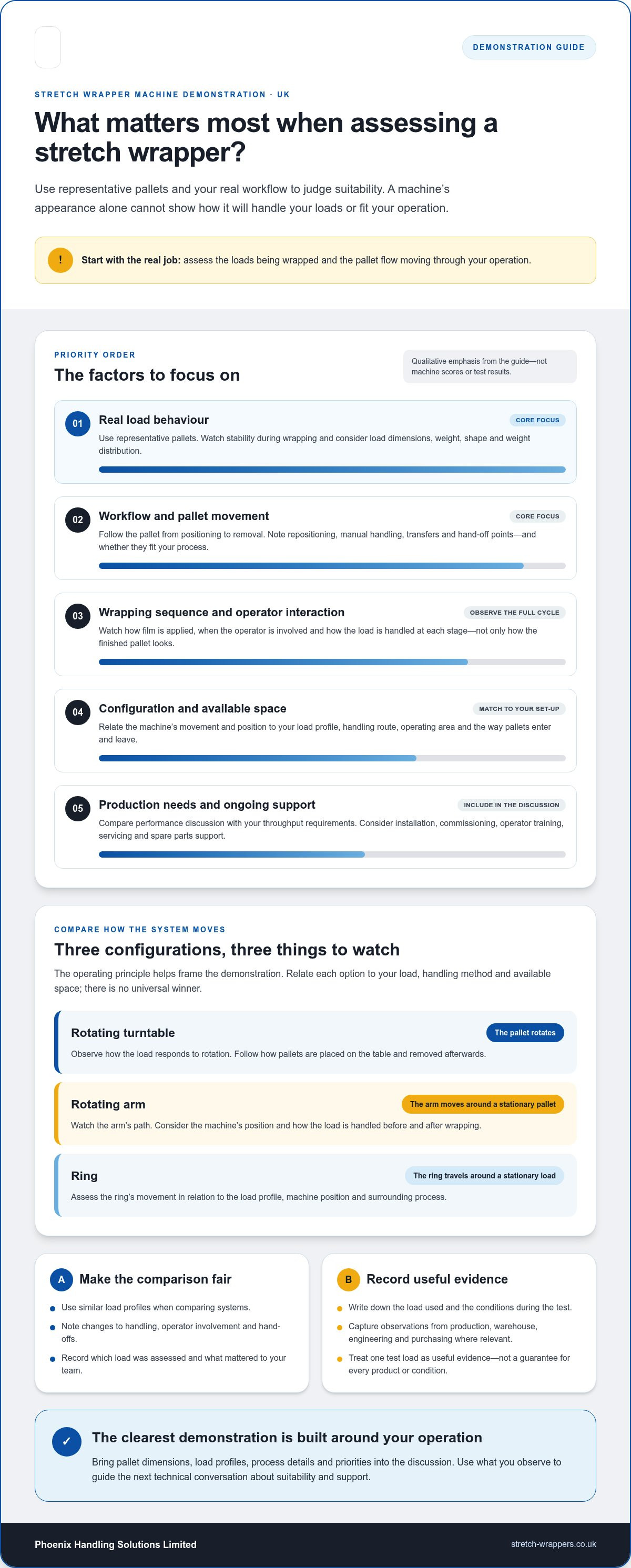
Assessing representative pallets and workflow can show how a machine handles load stability, wrapping consistency and production demands. It can also help you compare rotating turntable, rotating arm and ring systems against the way your operation handles pallets.
This guide explains what to observe, which questions to ask and what evidence to record. It covers load behaviour, machine operation and layout considerations, as well as how installation, commissioning, operator training, servicing and spare parts support fit into the decision.
Key Takeaways
- Assess real loads and workflow during a stretch wrapper machine demonstration, rather than relying on appearance alone.
- Compare turntable, rotating arm and ring configurations by how the pallet and wrapping system move, then relate that to your load requirements.
- Observe the wrapping sequence, operator interaction and hand-off points. Record what you see, but do not treat one test load as a guarantee.
- Prepare useful questions by gathering pallet dimensions, load profiles, process details and your operation’s priorities.
- Use your findings to guide the next technical discussion, including installation, commissioning, training and ongoing support.
Why arrange a stretch wrapper machine demonstration in the UK?
A machine demonstration lets you assess how a stretch wrapper performs against your packaging requirements, rather than relying on specifications or a general product presentation. The useful question is not simply whether the machine runs. It is how it handles the loads and pallet flow moving through your operation.
Watching the process makes practical details easier to judge. Follow how a pallet is positioned, what happens during the wrapping sequence, how the operator interacts with the machine and where the wrapped load goes next. Note any repositioning, manual handling or transfers between stages, and consider whether these steps fit your current arrangements.
Stretch wrapping applies film around a load to help contain it for handling and transport. The stretch wrap technology overview provides background on the material and different application methods. A demonstration helps you apply that general context to your own loads: how does a particular machine apply the wrap to the products your operation handles?
What can a stretch wrapper demonstration help you assess?
Watch the full sequence, from placing the pallet through to removing it, rather than concentrating only on the finished load. Note whether the load needs repositioning, when the operator is involved and whether the cycle creates a hand-off that fits your process. Record specific observations, including the load used and the conditions during the test. One load offers useful evidence, but it cannot show how every product or operating condition will perform.
Who benefits from seeing a machine in operation?
Where relevant, involve the people who understand different parts of the job. Production staff can consider how the wrapping stage fits output requirements; warehouse staff can focus on pallet movement and load handling; engineering can assess the machine’s position in the working area; and purchasing can compare those findings with project priorities. Sharing observations gives the team a common basis for discussion.
Before drawing conclusions, set out the conditions that matter. Suitability depends on the loads being wrapped, required throughput, available layout and the wider packaging process. A demonstration helps you assess those factors, but one configuration will not necessarily suit every pallet or shift.
Agree what you want to learn before the machine runs. If a pallet is awkward to handle or varies in shape, watch how it is positioned and contained during the cycle. If workflow is the main concern, follow the operator’s actions and each transfer point. This gives colleagues a shared focus and makes the next discussion more specific.
Which stretch wrapper configuration should your demonstration explore?
The main configurations differ in how they create movement: a turntable rotates the pallet, a rotating arm moves around a stationary load, and a ring travels around it. That distinction shapes what to watch, but it does not identify a universal winner. Relate the options to your product dimensions, pallet weight, load stability, handling method and available space.
Use this comparison as a starting point for a stretch wrapper machine demonstration. The principles of packaging systems and design principles include considering how goods are prepared for storage and transport. In practice, assess both the wrapped load and how the machine fits around the product and the process that moves it.
| Configuration | Operating principle | Potential fit and demonstration observations |
|---|---|---|
| Rotating turntable | The pallet rotates as film is applied. | Observe how the load responds to rotation, and how pallets are placed and removed within the workflow. |
| Rotating arm | The arm moves around a stationary pallet. | Watch the arm’s path and consider how the load is handled before and after wrapping. |
| Ring | A ring travels around the stationary load. | Assess the ring’s movement in relation to the load profile, machine position and surrounding process. |
What to observe on a turntable stretch wrapper
Follow the pallet from loading through rotation to unloading. Consider whether the load remains steady as the table turns, particularly if its shape or weight distribution makes handling a concern. Then assess the steps around the cycle: how the pallet reaches the table, where it goes afterwards and whether those movements fit the workflow without awkward transfers.
What to observe on rotating-arm and ring systems
Keep the load stationary and watch how the arm or ring moves around it. Consider the machine’s position in relation to the handling route and available operating space, then note how pallets enter and leave the wrapping area. If production pace is a priority, compare any performance discussion with your stated throughput requirements rather than assuming a configuration will meet them automatically.
For a fair comparison, use similar load profiles and note where each system changes the handling sequence, operator involvement or hand-off to the next stage. A tall, narrow pallet and a broad, uneven one may raise different questions. Record which load was assessed and what mattered to your team, so you can discuss suitability using specific observations rather than a general product overview.
As a practical next step, compare your load and workflow requirements with the available stretch wrapper configurations, then use the demonstration to explore the options that best match those priorities.
What should you evaluate during a stretch wrapper demonstration?
Follow the whole wrapping cycle, not just the finished pallet. Track how the load moves, how film is applied, what the operator does and how the wrapped pallet is handed on. Keep a clear record of what you observed, what still needs testing and what is an assumption.
As you watch, note specific evidence against your operating needs:
- Sequence: Record each stage from loading to removal, including pauses or manual tasks.
- Load behaviour: Notice any movement, tilting or change in shape as wrapping proceeds.
- Film coverage: Look at coverage across the base, corners, sides and top, where relevant to the load.
- Controls and adjustments: Ask which operating settings can be adjusted and how they relate to different load requirements.
- Handoffs: Observe how the pallet enters and leaves the wrapping area and whether this fits the next process stage.
How to assess load containment and film application
Check coverage across the load rather than judging only the visible front face. Look at the base, corners and top, and note any obvious gaps or movement. Relate what you see to the pallet’s shape and stability. A successful test with one load is useful evidence, but it does not establish how every product or pallet will behave.
Record film use as an operational measure, not as a guaranteed saving. If consumption matters to your decision, ask how the observed application was set up and what would need to be compared across representative loads. The wider stretch and shrink film market analysis provides broader context, but your assessment should remain grounded in your packaging requirements.
How to assess machine operation and operator interaction
Follow the cycle in order: loading, starting, wrapping, completion and pallet removal. Note the tasks the operator carries out, where they need access and whether the process interrupts nearby work. Ask how commissioning and operator training support correct day-to-day use, so your decision accounts for people and operating practice as well as the machine.
Keep observations separate from conclusions. For example, write “load shifted during rotation” rather than immediately deciding that the machine is unsuitable. Record the load profile and conditions, then discuss whether an operating adjustment, a different machine configuration or another test load would help clarify the result.
Before finishing, list any open questions about settings, control of the wrapping sequence, load variations and the next hand-off. Phoenix Handling Solutions supplies packaging machinery and provides installation, commissioning and operator training, bringing these practical considerations into the wider decision.
How to prepare representative pallets and questions for your demonstration
A useful demonstration starts before the machine runs. Prepare a clear picture of the loads, handling steps and priorities your operation needs to accommodate. Bring information about typical pallets as well as awkward or less stable loads, so the evaluation is not based on an ideal example alone.
Use this preparation sequence to organise what you’ll share:
- Gather load details. Note pallet dimensions, approximate weight where known, load height and shape, and any variations that could affect stability.
- Describe the process. Explain how pallets reach the wrapping point, how they are handled there and where they go afterwards.
- Define priorities. Identify what matters most, such as fitting the wrapping stage into the current workflow, handling varied loads or meeting an agreed production requirement.
- Record questions. Capture anything you need to understand about machine operation, implementation and ongoing support.
Which load and process details should you bring?
Include a typical pallet and challenging formats, such as loads that vary in shape, height or stability. Bring dimensions where available and describe how consistently products are stacked. Explain what handling equipment moves pallets to and from the wrapping point, the current wrapping steps, operating patterns and any space or workflow constraints. These details keep the demonstration tied to your real process.
Explain what changes between shifts or product types. A load that is straightforward to wrap in one format may raise different handling questions when its shape or stability varies. Note those differences rather than trying to represent every pallet with a single example.
Which questions help make the demonstration useful?
Ask how the machine’s operating principle relates to the loads and workflow you have described, and which observations will help assess that fit. Discuss installation, commissioning and operator training as part of implementation. Include servicing, service contracts and spare parts in your view of ongoing operation. This connects the test with the practical steps involved in adopting and supporting machinery.
- Which load details or operating conditions should inform the machine discussion?
- How will the wrapping process fit with the way pallets are currently handled?
- What information is needed to plan installation, commissioning and operator training?
- How do servicing and spare parts support the machine over its working life?
After the demonstration, keep your notes with the load details and priorities you brought. This helps separate what the team observed from what still needs discussion, and identifies the project information needed for a tailored next step.
Talk through your stretch wrapping requirements with Phoenix Handling Solutions and use your preparation notes to guide the conversation.
Arrange a UK stretch wrapper machine demonstration and plan the next step
A demonstration is most useful when its findings lead to a practical project discussion. Review what the team observed against the requirements set beforehand: load fit, wrapping process, operator involvement, hand-off points and operational priorities. Use the findings to identify both a promising fit and the details that still need working through.
What happens after you have assessed the machine?
Bring the observations together with the stakeholders who will own, operate or maintain the equipment. Compare the demonstration notes with the load information, workflow and constraints you recorded beforehand. Separate clear findings from open questions, then identify what project information would help resolve them, such as details about the site layout or pallet handling process.
Discuss next steps in context. If the machine appears suitable, consider how it will fit into the operation and what is involved in planning installation and commissioning. Think about the people who will use the equipment, the process around it and how it will connect with existing packaging stages. This grounds the decision in implementation as well as machine behaviour.
How Phoenix supports the machinery lifecycle
Phoenix Handling Solutions is the UK sales agent for Tosa S.P.A. stretch-wrapping machines, supplying rotating turntable, rotating arm and ring systems. The company also provides installation, commissioning and operator training, bringing the practical requirements of setting up and using equipment into the project discussion.
Ongoing operation matters too. Phoenix provides machine servicing, service contracts and spare parts support, helping customers plan how machinery will be maintained over its working life. Discuss these options alongside the demonstration to connect the initial assessment with support after the machine is in place.
Before deciding on the next step, summarise the outcome under a few headings:
- Load fit: Which loads were assessed, and what questions remain for other formats?
- Process fit: How did loading, wrapping and onward handling relate to the current workflow?
- People and priorities: What did operators and other stakeholders identify as important?
- Project planning: What information is needed to discuss installation, commissioning, training and ongoing support?
A demonstration is one part of the decision, not a final answer on its own. It provides a basis for a tailored conversation about machine suitability and the steps that follow. To discuss your loads and operating requirements, talk through your stretch wrapping requirements with Phoenix Handling Solutions and plan your next step.
Turn your demonstration findings into a practical next step
Use the observations from a stretch wrapper machine demonstration to shape a clear project brief. Note which requirements the demonstration addressed, what still needs discussion and which colleagues should contribute before a decision. This keeps the next conversation focused on your operation rather than general machine features.
Phoenix Handling Solutions is the UK sales agent for Tosa S.P.A. stretch-wrapping machines, with installation, commissioning and operator training for supplied machinery. Servicing, maintenance contracts and spare parts support can also form part of planning for ongoing machine care, giving you a broader view of the decision beyond the demonstration.
To move from observations to a tailored discussion, discuss your stretch wrapper requirements with Phoenix Handling Solutions. Talk through outstanding questions and identify a suitable next step for your operation.
Frequently Asked Questions
What happens during a stretch wrapper machine demonstration?
A useful demonstration follows the machine’s operating sequence against your stated load and process requirements. Observe how a pallet is positioned, how film is applied, what the operator does and how the wrapped load is removed or passed on. Bring questions about steps that differ from your current process. The demonstration informs a practical suitability discussion, but one test does not guarantee identical results for every load or site.
Can I use my own pallets during a stretch wrapper demonstration?
Representative pallets make an evaluation more relevant, particularly if loads vary in dimensions, shape or stability. Share available load details, such as pallet size, approximate weight and how consistently products are stacked, then choose examples that reflect your operation. The aim is to assess the machine against your requirements, not just an ideal sample.
How do I choose the right stretch wrapper for my production line?
Relate load characteristics and site constraints to how pallets move through your process. A turntable rotates the pallet, while a rotating arm or ring moves around a stationary load. Consider which operating principle best fits your handling method, working space and production priorities. A stretch wrapper machine demonstration can make that comparison practical, using your project requirements rather than a general ranking of machine types.
What should I look for when testing pallet load containment?
Observe how the film covers the pallet, including corners and the upper and lower areas, and note any movement during wrapping. Consider the load’s shape, stability and containment requirements, since these affect what a useful result looks like. Record observations alongside load details and operating conditions. A single demonstration can inform your assessment, but it does not guarantee the same outcome for every load.
Does Phoenix Handling Solutions install and commission stretch wrappers?
Yes. Phoenix Handling Solutions provides installation and technical commissioning for supplied packaging machinery, alongside operator training. These steps help prepare the equipment and the people who will use it. As part of your project discussion, consider how installation and commissioning relate to the planned machine location and process, and what operators need to learn for day-to-day use.
What support is available after a stretch wrapper is installed?
Phoenix provides machine servicing, maintenance contracts and spare parts support for ongoing equipment care. These options help you plan how servicing and replacement parts fit into the machine’s operational lifecycle. Consider who will oversee its care and what support approach suits your operation. This gives you a fuller basis for planning beyond the initial installation, without assuming a particular service level or guaranteed uptime.
Can a stretch wrapper demonstration help compare turntable, arm and ring machines?
Yes. A demonstration can help you compare how each operating principle relates to pallet movement, load handling and your workflow. Apply the same project requirements to each discussion, noting observations that matter to your operation, such as how a load is handled or how the wrapping stage connects with the next process. The appropriate configuration depends on the application and operational priorities, not a generic ranking of machine types.


