

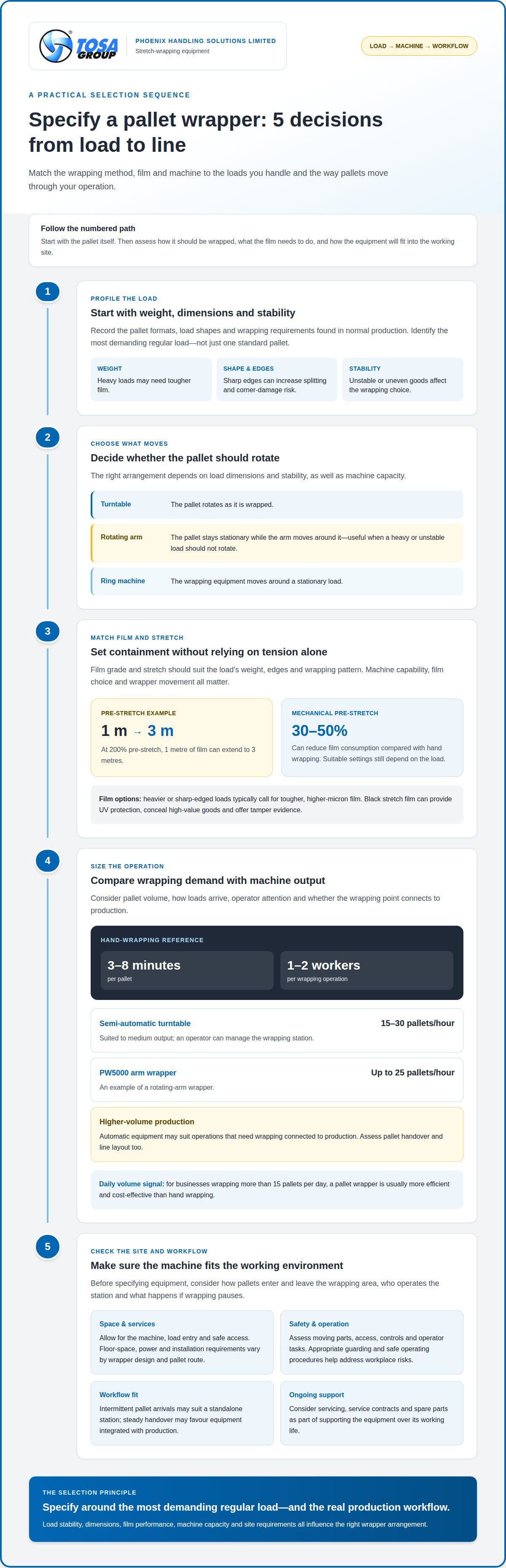
The heaviest pallet isn’t always the one that should rotate on a turntable. A pallet wrapper for heavy loads applies stretch film under controlled tension to contain the load; with 200% pre-stretch, 1 metre of film can extend to 3 metres. For loads that are oversized, unstable or awkward to move, a rotating-arm arrangement can wrap around a stationary pallet instead.
Keeping a heavy load secure without slowing wrapping is a practical concern in busy warehouses. This guide explains how machine-applied stretch wrap works, how pre-stretch affects film use, and when mobile wrapping may suit heavy, oversized or unstable pallets. It also covers how load weight, dimensions, stability and wrapping requirements inform the choice between turntable, rotating-arm and ring wrappers, helping you assess the options for your operation.
Key Takeaways
- Understand how pre-stretch turns a metre of film into a longer length, and why the setting affects film consumption.
- See how machine-applied wrapping controls film tension more consistently than hand wrapping.
- Choose between semi-automatic and automatic equipment by considering load size, wrapping volume and whether the line uses conveyors.
- If you stack two 300kg pallets, secure them as if they were a 600kg pallet, according to UK Government.
Stretch-film pre-stretch and consumption
Pre-stretch determines how far film extends before it is applied, affecting film consumption and the tension placed on the pallet load. Film choice and wrapper movement also influence stability, particularly with heavy or uneven goods.
Matching Film Stretch to Machine Capability
A machine’s pre-stretch setting must suit the film and the shape of the load. Pre-stretch can extend film, while power pre-stretch film is stretched during manufacture and may require less tension during application. Mechanical pre-stretch can reduce film consumption by 30%-50% compared with hand wrapping, but suitable settings still depend on the load.
Turntable wrappers rotate the pallet, while rotating-arm and ring machines move the film around a stationary load. Keeping a heavy pallet stationary can avoid rotating an unstable stack. The right choice depends on the load’s dimensions and stability, as well as the machine’s capacity.
Film Options for Different Load Weights
Light, regular loads may need less film strength than heavy pallets or goods with sharp edges. Heavier or sharp-edged loads typically call for tougher, higher-micron film to help reduce splitting and corner damage. Match film grade and stretch to the load’s weight, edges and wrapping pattern instead of relying on tension alone.
Black stretch film can provide UV protection, conceal high-value goods and offer tamper evidence. Machine-applied film can deliver consistent application and controlled tension to support containment and reduce waste. Both the wrap pattern and film performance affect load stability.
UK machinery and workplace safety requirements depend on the machine and installation. Assess moving parts, access, controls and operator tasks. Appropriate guarding and safe operating procedures help address risks such as contact with moving equipment or an unstable pallet shifting during wrapping.
Floor-space, power and installation requirements vary by wrapper design and pallet route. Plan space for the machine, load entry and safe access, then ensure the site’s floor and electrical provision meet the equipment requirements during installation.
What is machine applied stretch wrap?
Machine-applied stretch wrap is film applied around a pallet load by a wrapping machine. Turntable, rotating-arm and ring machines move either the pallet or the wrapping equipment to cover the load. This helps create consistent containment for storage, manufacturing and despatch.
Hand wrapping takes 3-8 minutes per pallet and requires 1-2 workers per wrapping operation. A machine can apply film more consistently, while reducing the manual wrapping task. For businesses wrapping more than 15 pallets per day, a pallet wrapper is usually more efficient and cost-effective than hand wrapping. Film must also match the machine specifications for reliable application.
Output helps guide the choice. Semi-automatic turntable machines suit medium output of 15-30 pallets per hour, whilst higher-volume operations may need automatic equipment connected to production. The PW5000 arm wrapper can wrap up to 25 pallets per hour. A machine’s role in the line, pallet dimensions and load stability also affect suitability.
For UK operations seeking a heavy-duty wrapper and servicing, the practical supplier fit is one that can match equipment to loads and provide ongoing machine support. Leasing is a separate purchasing arrangement, so consider it alongside equipment needs rather than as a wrapping-machine feature. Machine servicing and service contracts can help support equipment over its working life, while spare parts help address maintenance requirements.
For a closer look at equipment types, explore industrial stretch wrappers and consider how each could fit your pallet volume and production flow.
Why choose a pallet wrapper?
Look beyond headline output when choosing equipment: consider how packaging work fits each shift and who will operate the wrapping point. A pallet wrapper for heavy loads needs to suit the real production routine, including batch changes, pauses and the operator attention available.
A semi-automatic machine may suit a warehouse where pallets arrive intermittently and an operator can manage the wrapping station. Map who brings each pallet forward and how wrapping fits alongside other duties. This shows whether a separate workstation is practical or likely to interrupt other operations.
Consider automatic equipment when wrapping must fit into a production process with a steady handover between stages. Assess how pallets enter and leave the wrapping area and whether the machine fits the line layout. An automatic pallet wrapper does not, by itself, automate complete pallet movement, so the surrounding workflow still matters.
Mixed product batches need careful assessment. Record the pallet formats, load shapes and wrapping requirements found in normal production, then identify the most demanding regular load. This provides a better basis for specifying equipment than choosing around just one standard pallet.
Consider the consequences of a stoppage at the wrapping point. If a pause could hold up production or despatch, assess the machine’s role in the wider packaging process. Where loads arrive irregularly, a standalone arrangement may fit better than equipment closely integrated with a continuous line.
For a practical comparison, document the workflow, operator responsibilities, pallet variations and likely impact of interruptions. Use these details to assess whether a semi-automatic or automatic machine suits the operation. A pallet wrapper for heavy loads should support day-to-day handling without adding avoidable complexity.
Mobile pallet wrapping for heavy, oversized and unstable loads
Mobile wrapping can help when bringing a heavy or awkward pallet to a turntable is difficult. A rotating-arm wrapper keeps the pallet stationary while the arm moves around it, which can suit loads that should not rotate. Choose the wrapping method according to the load, its stability and its route through the warehouse.
Weight still matters. Some rotating-arm and ring wrappers have a maximum pallet weight of 2,000 kg, so the total load must stay within the selected machine’s capacity. Stacked pallets need particular care: according to UK Government, if you stack two 300 kg pallets, secure them as if they were a 600 kg pallet.
For safe, efficient handling, position the pallet securely and keep the load stable during stretch wrapping. Apply film to secure the goods to the pallet; the NHS states that products must be securely wrapped to pallets using stretch or shrink wrap. Complete the cycle before moving the load, then use suitable handling equipment to transport it. A consistent wrap supports containment during storage and transport.
An unstable load may shift if its base is uneven or its upper layers are poorly aligned. A turntable rotates the pallet, so consider whether that movement suits the load. With a stationary pallet and rotating arm, the load does not need to turn. For oversized loads, check the wrapper’s working dimensions, wrapping height and access around the machine, not just its capacity.
Match the machine to the pallet’s weight, dimensions and stability, then consider how it will be loaded, wrapped and removed. Explore rotating-arm stretch wrappers to see how stationary-load wrapping could fit your warehouse handling process.
Phoenix Handling Solutions Limited: Pallet wrappers
Phoenix Handling Solutions Limited supplies pallet wrappers for warehouses handling heavy, oversized or unstable loads. Its range includes rotating turntable, rotating-arm and ring stretch wrappers, offering different ways to apply film around palletised goods.
The right arrangement depends on the load and how it moves through your operation. A turntable rotates the pallet during wrapping, while a rotating-arm or ring wrapper can keep it stationary. Weight, dimensions, stability and production flow help determine which machine is practical, particularly when turning a heavy pallet may be unsuitable.
If you’re reviewing equipment for a specific pallet or warehouse process, contact Phoenix Handling Solutions Limited to discuss your requirements.
Plan the next step for your warehouse
A useful next step is to prepare a clear equipment brief. Note which load shapes cause difficulty, how pallets move through the warehouse and whether the wrapping point needs to fit an existing process. These details provide a practical starting point for discussing a pallet wrapper for heavy loads, because different pallets can present very different handling challenges.
Phoenix Handling Solutions Limited supplies rotating turntable, rotating-arm and ring stretch wrappers. Each format handles pallet movement differently, so a discussion can focus on your loads and the machine arrangement that best suits your workflow.
If you’re ready to discuss the requirements for your warehouse, contact Phoenix Handling Solutions Limited. A straightforward discussion can help you take the next step towards a wrapping setup that fits your operation.
Frequently Asked Questions
How do I choose the right stretch percentage for my needs?
Choose a pre-stretch level that the machine and film can handle whilst keeping the load contained. High-stretch films are typically described as delivering 250% or more performance with powered pre-stretch machines. Treat that as a capability, not an automatic target: consider the pallet’s shape, weight and edges, then assess whether the applied film holds the load securely without excessive tension.
What types of pallet wrappers are suitable for heavy loads?
Turntable, rotating-arm and ring wrappers can all suit heavy pallets, depending on how the load can be moved. A turntable rotates the pallet; an arm or ring wrapper can apply film around a stationary load. If a stacked or unstable pallet should not rotate, a stationary-load arrangement may be more suitable. Also consider pallet dimensions and how goods reach the wrapping point.
What maximum load weights do heavy-duty pallet wrappers support?
Maximum capacity depends on the wrapper model. The examples covered here include a maximum pallet weight of 2,000 kg for the PW5000 arm wrapper and the rotating-ring pallet wrapper. Treat those as model-specific limits, not a universal capacity for every machine. Account for the complete palletised load, including stacked pallets, and select equipment rated for that total weight.
What pallet wrapper features are needed for unstable, tall or irregular loads?
For a load that should remain stationary, consider a rotating-arm or ring wrapper, where the wrapping mechanism travels around the pallet. Check the machine’s allowable pallet dimensions and wrapping height against your largest or most awkward load. For irregular shapes, consider a film application pattern that contains protruding sections without pulling them out of position.
What are the running costs of pallet wrapping heavy loads, including film use?
Running costs depend on film consumption, wrapping settings, operating volume, servicing and replacement parts. To assess film use, record consumption across a consistent group of pallets and compare similar loads and wrap patterns. Include maintenance requirements in the operating budget. Purchase price and ongoing costs vary by equipment and application, so a generic estimate may not be useful.
How do I choose the right stretch film and wrapping settings for heavy pallets?
Start with the load’s weight, sharp edges, shape and transport conditions, then match the film grade and stretch to the wrapper’s capabilities. Tougher, higher-micron film can help reduce splitting and corner damage on heavy or sharp-edged pallets. Set the application to contain the goods without destabilising them, using a consistent wrap pattern suited to the pallet’s shape.


