

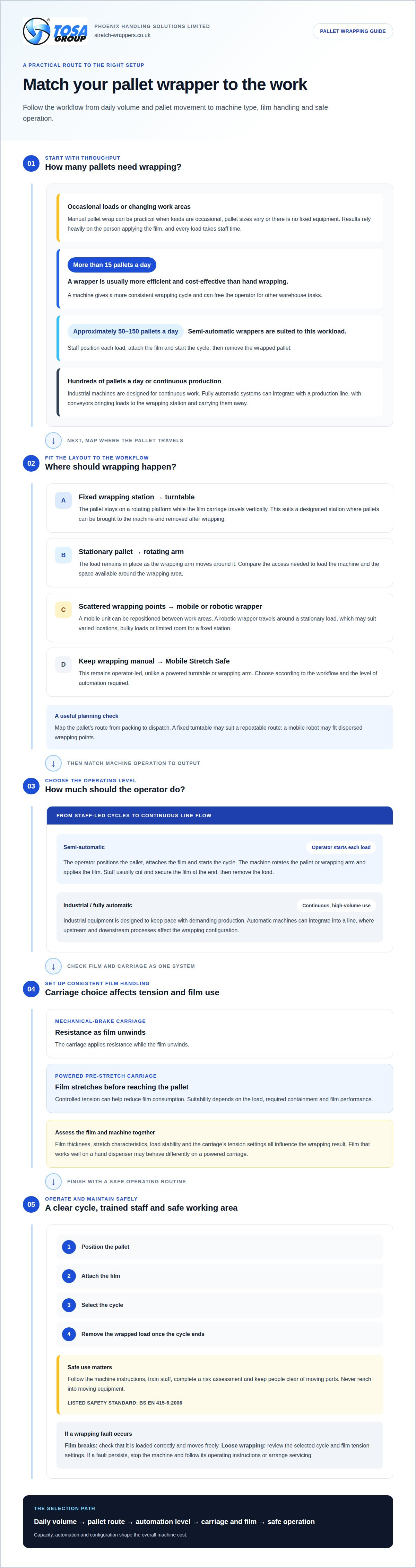
For businesses wrapping more than 15 pallets per day, a pallet wrapper machine is usually more efficient and cost-effective than hand wrapping. The right setup depends on your throughput and how much automation your operation needs, with semi-automatic and industrial machines suited to different workloads.
It’s understandable to weigh the upfront investment against the time and materials involved in wrapping pallets by hand. The price depends on the machine’s capacity, automation and configuration, and is provided after a quote request.
This guide explains why businesses choose pallet wrappers, how semi-automatic machines differ from industrial models, and which options may suit your operation. It also covers the practical factors that shape cost, so you can make a more informed decision about the equipment and support your team needs.
Key Takeaways
- Match the wrapping method to your workflow: manual, turntable and robot systems suit different levels of handling and automation.
- Consider how throughput and continuity affect the choice between semi-automatic equipment and industrial models.
- Compare machine options by looking at capacity, automation and configuration, the factors that shape overall cost.
- Understand the safety standard relevant to pallet wrapping machines and how safe operation fits into choosing equipment.
What is the difference between a semi-automatic and industrial stretch wrap machine?
A pallet wrapper machine applies stretch film around a loaded pallet to help secure products for handling and transport. With semi-automatic equipment, an operator positions the load and attaches the film; the machine then rotates the pallet or wrapping arm and applies the film. Automatic industrial models can integrate into production lines and are designed for continuous, high-volume use.
The main difference is how much work the operator does and how consistently the machine can keep running. Semi-automatic machines need an operator to start each load and usually cut and secure the film at the end. Industrial equipment can better suit demanding, continuous production lines, where wrapping must keep pace with upstream and downstream processes.
The film carriage affects tension and film use. A mechanical-brake carriage applies resistance as film unwinds, while a powered pre-stretch carriage stretches film before it reaches the pallet. Pre-stretch can help reduce film consumption by applying controlled tension. The suitable carriage depends on the load, the containment required and the film’s performance.
Machine stretch film needs to suit the carriage’s film handling and tension settings. Film thickness, stretch characteristics and load stability all influence the wrapping result. Film that performs well on a hand dispenser may behave differently on a powered carriage, so assess the film and machine as a working combination.
A Mobile Stretch Safe manual wrapping system remains operator-led, unlike a powered turntable or wrapping arm. It may suit operations that retain manual wrapping, while a machine provides repeatable movement and controlled film application. The right choice depends on the workflow and the level of automation required.
For safe operation, follow the machine’s instructions: position the pallet, attach the film, select the cycle, then remove the wrapped load once the cycle ends. Staff training and a risk assessment support safe use. According to the UK Government, the HSE lists BS EN 415-6:2006 as the safety standard for pallet wrapping machines.
Why choose a pallet wrapper?
For businesses wrapping more than 15 pallets per day, a wrapper is usually more efficient and cost-effective than hand wrapping. Manual pallet wrap can be practical for occasional loads, changing pallet sizes or work areas without fixed equipment. However, results depend heavily on the person applying the film, and wrapping each load takes staff time. A machine makes the wrapping cycle more consistent, while freeing the operator for other warehouse tasks.
A turntable wrapper keeps the pallet in one position on a rotating platform. As the load turns, the film carriage travels vertically to wrap it. This arrangement suits a designated wrapping station where pallets can be brought to the machine and removed after the cycle. It’s a practical option for mechanising a regular wrapping task without moving the equipment around the warehouse.
A mobile robotic wrapper takes the equipment to the pallet. It travels around a stationary load, applying film without requiring the pallet to move onto a turntable. This can suit warehouses with varied wrapping locations, bulky loads or limited room for a fixed station. The operator still needs to prepare the film and load, then use the equipment according to its operating instructions.
Mobile and robotic wrappers differ from fixed turntable systems. A mobile unit can be repositioned between work areas, while a robotic wrapper moves around the load during wrapping. Consider where pallets are built, how they travel through the warehouse and whether a fixed station fits the workflow. The suitable method is one that secures loads consistently without adding unnecessary handling steps.
To compare options, map the pallet’s route from packing to dispatch, then identify where wrapping will cause least disruption. A fixed turntable may suit a repeatable route; a mobile robot may fit dispersed wrapping points. Explore stretch wrapping systems to see how machine layouts differ.
Semi-automatic pallet wrapping machine range
Semi-automatic wrappers suit operations wrapping approximately 50-150 pallets per day. An operator positions each load, attaches the film and starts the cycle, then removes the wrapped pallet. This solution reduces repeated hand wrapping while keeping loading and unloading under staff control. It can suit a warehouse where pallets arrive individually rather than along a continuous line.
Machine choice depends on volume and how loads move through the site. A turntable rotates the pallet during wrapping, while a rotating arm moves around a stationary load. Both can support semi-automatic operation, with different layouts for different pallet-handling arrangements. Compare the access needed to load each machine and the space available around the wrapping area.
Industrial machines are designed for continuous work, including operations handling hundreds of pallets per day. Fully automatic pallet wrappers can form part of a production line, where conveying equipment brings loads to the wrapping station and carries them away. Automation can reduce manual handling at the wrapping stage, but the right configuration depends on line flow, load stability and the space available.
For UK safety, staff need safe-operation procedures, training and a risk assessment. According to the UK Government, the HSE lists BS EN 415-6:2006 as the safety standard for pallet wrapping machines. Follow the machine instructions and keep people clear of moving parts during operation.
Common faults include film breaking, loose wrapping or a cycle stopping unexpectedly. If film breaks, check that it is loaded correctly and the roll moves freely. For loose wrapping, review the selected cycle and film tension settings. If a fault persists, stop the machine and follow its operating instructions or arrange servicing. Never reach into moving equipment.
UK buyers can source semi-automatic and automatic systems from machinery manufacturers and specialist packaging-equipment suppliers. Compare machine type, automation level, film carriage and support arrangements with your operation’s needs. Start by mapping pallet volumes and movement, then decide whether manual loading or an automatic line best fits the workflow.
Pallet wrapper machine prices
The price of a pallet wrapper depends on its configuration, capacity and level of automation. A basic semi-automatic setup and a fully automatic line serve different packaging operations, so a single figure can’t describe both. The cost depends on the case and is given after a quote request. Key factors include machine type, load dimensions, throughput, film carriage and the installation required.
Start by matching the equipment to the wrapping task. A turntable system rotates the pallet, while a rotating arm wraps a stationary load. A ring system uses a different wrapping arrangement. The format affects the machine’s design and how it fits the site. For example, a fixed wrapping point and a production line may need different configurations.
Automation also affects the overall investment. With semi-automatic equipment, an operator handles tasks such as positioning the pallet and starting the cycle. An automatic system can integrate with a production line, bringing conveying and control requirements into the project. Compare how each option fits your workflow and required output, not just its purchase cost.
Consider what the machinery project needs to include. Installation, commissioning and operator training can be provided alongside the equipment. Site layout, access for pallet movement and connections to existing packaging processes can influence the work involved. Clear requirements help define a like-for-like specification before comparing proposals.
For a practical estimate, set out your pallet sizes, wrapping volume, current method and desired level of automation. Include any constraints around floor space or production-line integration. These details help match the machine to the job rather than paying for capacity or features the operation won’t use. To discuss a suitable configuration, request a stretch wrapper quote.
Phoenix Handling Solutions Limited: Machine servicing and service contracts
Phoenix Handling Solutions Limited provides machine servicing and service contracts for businesses that rely on pallet-wrapping equipment. If a wrapper develops a fault, its cycle becomes inconsistent or routine maintenance is due, servicing can address the equipment’s operational needs. Service contracts provide an ongoing maintenance option for businesses seeking planned care alongside day-to-day production.
Phoenix Handling Solutions Limited supplies pallet wrappers, including rotating turntable, rotating arm and ring stretch wrappers, as well as strapping machines. The right equipment and service arrangement depends on how machinery fits your operation, from the wrapping task to the wider packaging process. Whether you’re planning a new installation or need servicing for equipment already in use, PHS can discuss your practical requirements.
Contact Phoenix Handling Solutions Limited to discuss machine servicing or a service contract for your operation.
Choose a wrapper that fits your next step
Before selecting a pallet wrapper machine, consider how your wrapping process may need to change as production shifts. A setup that fits today’s pallet flow should also work with how goods move through your warehouse, from packing to dispatch. Mapping that route helps make equipment selection a practical decision, rather than a choice based on the machinery alone.
Phoenix Handling Solutions Limited supplies rotating turntable, rotating arm and ring stretch wrappers. These options provide different ways to incorporate wrapping into your operation, depending on how pallets are handled and where the wrapping stage sits. With the process in view, it’s easier to discuss suitable equipment and support.
If you’re ready to talk through the next step, contact Phoenix Handling Solutions Limited about your pallet wrapping requirements. A practical conversation can help you move towards a setup that works for your operation.
Frequently Asked Questions
What types of pallet wrapping machines are available?
Options include manual, semi-automatic and automatic machines, alongside turntable, rotating arm, ring and mobile robotic designs. A pallet wrapper machine can keep the pallet stationary or rotate it, depending on the wrapping method. The right layout depends on how loads move through the packing area. Automatic wrapping can reduce operator involvement, but pallet supply and removal may still need conveyors or staff.
How much does pallet wrapping equipment cost in the UK?
The price of a pallet wrapper machine depends on its configuration and the operation’s requirements. Factors include the wrapping method, automation level, throughput, pallet dimensions, film carriage and integration with an existing line. Installation and commissioning requirements also shape the project. Pricing is provided after a quote request, based on the specified equipment and site needs.
How do semi-automatic and automatic pallet wrappers compare?
A semi-automatic wrapper leaves more of each cycle to the operator, including presenting the pallet and starting the wrap. An automatic model can integrate into a production line and reduce manual involvement at the wrapping point. However, automation does not necessarily cover pallet supply, transfer or removal. Consider which tasks staff will still perform and whether conveyors are needed to connect the wrapping station.
How do I choose a pallet wrapper for different pallet sizes and production volumes?
Start with the range of loads you wrap, including their footprints, heights, stability and variation. Then consider normal and peak production periods, where pallets are built, and how they reach dispatch. A pallet wrapper machine should accommodate the load mix and fit the available floor space. Include the largest or least stable loads when discussing the equipment specification.
How do I operate and maintain a pallet wrapping machine safely?
Use the machine’s operating instructions, complete a risk assessment and train staff in safe operation before production begins. Keep the wrapping area organised, position loads as instructed and ensure operators know how to stop the cycle safely. For maintenance, follow the manufacturer’s schedule and isolation instructions. Report recurring film breaks or cycle faults rather than bypassing safety procedures.


