

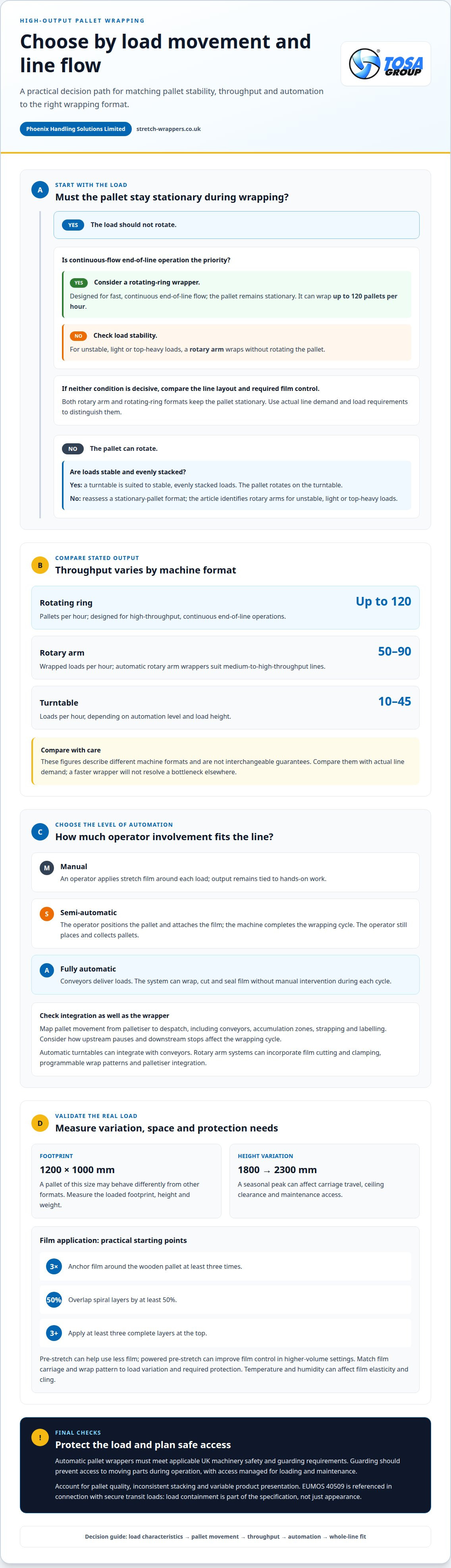
High output doesn’t always mean making the pallet spin faster. Rotary ring wrappers are designed for high-throughput end-of-line operations, and a ring wrapper can wrap up to 120 pallets per hour while the pallet remains stationary. For a pallet wrapper for high output production, that difference can matter when loads are unstable or the line needs a steady flow.
It’s understandable to focus first on wrapping speed, but the right machine also depends on load size and stability, the level of automation needed, and how wrapping fits with conveyors and other end-of-line equipment. A faster wrapper won’t solve a bottleneck elsewhere in the line.
This comparison explains how turntable, rotary arm and rotating-ring systems differ, what to consider when assessing pallet loads and line flow, and when a stationary-pallet ring system may suit the job. You’ll get a practical way to compare automation options and identify the factors that should guide a high-output wrapping decision.
Key Takeaways
- Match the wrapper to pallet dimensions, load stability and variations in how products are stacked, not just the usual load profile.
- Compare manual, semi-automatic and automatic systems by how much operator involvement your production flow can accommodate.
- Assess conveyors, accumulation areas and wrapping equipment as one end-of-line system to avoid shifting a bottleneck rather than resolving it.
- Consider a rotating-ring system when continuous pallet flow and keeping loads stationary are important to the operation.
Assessing pallet load characteristics and wrapping requirements
Start with the load, not the machine: a 1200 x 1000 mm pallet may behave differently from other formats. Measure the loaded footprint, height and weight, then note how consistently products are stacked.
Seasonal changes matter too. A load usually standing 1800 mm high may reach 2300 mm during peak production, affecting carriage travel, available ceiling clearance and the space needed for maintenance access.
Load protection and transit stability
Automatic pallet wrappers must meet applicable UK machinery safety and guarding requirements. Guarding should prevent access to moving parts during operation, with access managed for loading and maintenance. Poor pallet quality, inconsistent stacking and variable product presentation can also affect wrapping performance and load stability during transport or storage.
Compare how each machine handles pallet movement: a turntable rotates the load, while a rotary arm wraps without rotating it. EUMOS 40509 is referenced in connection with secure transit loads, so load containment is part of the specification, not just a question of appearance.
Wrapping speed and film use
Pre-stretch systems can help operations wrap more pallets using less film, while powered pre-stretch can improve film control in higher-volume settings. The film carriage and wrap pattern also affect application. Match the system to load variation and the required protection, rather than assuming a tighter wrap always creates a more stable load.
As a practical starting point, anchor film around the wooden pallet at least three times, overlap spiral layers by at least 50%, and apply at least three complete layers at the top. Temperature and humidity variations can affect film elasticity and cling, so account for storage conditions.
| Machine option | Load characteristics | Pallet movement | Space and film considerations |
|---|---|---|---|
| Turntable | Stable, evenly stacked loads | Pallet rotates | Allow room for turntable and carriage |
| Rotary arm | Unstable, light or top-heavy loads | Pallet stays stationary | Check arm clearance and carriage travel |
| Rotating ring | Continuous-flow operations | Pallet stays stationary | Consider line layout and film control |
Choose by comparing your widest and tallest loaded footprints, stability needs, available floor and ceiling space, and the film control required to protect loads in transit.
Automation choices for high-output packaging operations
Automatic rotary arm wrappers suit medium-to-high-throughput lines. Rotary ring wrappers are designed for fast, continuous end-of-line flow.
Manual wrappers require an operator to apply stretch film around each load, so output remains tied to hands-on work. Semi-automatic machines reduce that task: an operator positions the pallet and attaches the film, then the machine completes its wrapping cycle. Choose based on whether this level of operator involvement fits the pace and layout of your packaging operation.
Fully automatic wrapping
Fully automatic systems use conveyors to deliver loads and can wrap, cut and seal film without manual intervention during each cycle. This differs from semi-automatic operation, where an operator still places and collects pallets. Automatic rotary arm wrappers generally produce 50 to 90 wrapped loads per hour, while turntable systems can wrap 10 to 45, depending on automation level and load height.
Production-line integration
Conveyorised automation connects the wrapper with upstream production and downstream handling, coordinating pallet movement rather than relying on forklift placement at the machine. Automatic turntable wrappers can integrate with conveyor systems, while rotary arm systems can incorporate film cutting and clamping, programmable wrap patterns and palletiser integration. These functions help match the wrapping cycle to the line's sequence.
For fast, continuous flow, rotary ring wrappers are designed for high-throughput end-of-line operations and can handle up to 120 pallets per hour. Rotary arms generally produce 50 to 90 wrapped loads per hour; turntables handle 10 to 45, depending on automation and load height. These figures describe different machine formats, so compare them against actual line demand rather than treating them as interchangeable guarantees.
Choose automation by weighing required throughput against operator involvement, load handling and line integration. Where unstable loads shouldn't rotate, a rotary arm or ring format keeps the pallet stationary during wrapping. For comprehensive systems tailored to a pallet wrapper for high output production, explore the range available from Phoenix Handling Solutions Limited.
Coordinating conveyors, accumulation zones and wrapping
A wrapping machine works best as part of the full end-of-line flow, not as an isolated station. Map the route from palletiser to despatch, including conveyor transfers, accumulation zones, strapping and labelling, so each handover has a clear purpose.
Start with the production sequence: identify where pallets arrive, where they wait and what happens after wrapping. For example, a pallet may move from a palletiser onto a conveyor, pause in an accumulation zone, pass through the wrapper, then continue to strapping and labelling. The order depends on how the finished load must be handled and identified.
Accumulation gives the line room to respond to temporary bottlenecks or production peaks, but it must suit the actual flow. If wrapping pauses, an upstream zone can hold arriving pallets; if downstream handling stops, the wrapper may need to pause too. Assess these interactions together rather than sizing conveyors and wrapping equipment as separate projects.
Include load variation in the layout. A conveyor that handles a stable, regular pallet may behave differently with a wider footprint or uneven load. Check transfer points, turning space and the wrapping machine’s position against the loads moving through the facility. For rotary arm systems, keep the arm’s travel clear of adjacent equipment and traffic routes.
- Before wrapping: plan pallet flow from the palletiser and any accumulation area.
- At the wrapper: allow for load movement, film application and safe access.
- After wrapping: position strapping and labelling around the required handling sequence.
Rotary ring systems can integrate with palletisers, conveyors, strappers and hooding systems, connecting several end-of-line stages. Optional pallet conveyors can reduce forklift handling between these stages, while the layout should still allow maintenance access and accommodate changes in load presentation.
Size the system around real production flow, product diversity and planned operational changes. This joined-up approach helps prevent a fast wrapping machine from simply moving the bottleneck to accumulation, strapping or despatch.
Rotating-ring wrapping with a stationary pallet
A rotating-ring wrapper moves the film carriage around a stationary pallet, making it suited to fast production lines with continuous pallet flow. The Ring Wrapper can wrap up to 120 pallets per hour, while keeping the load from rotating during application.
For production speed, turntable wrappers can handle 10 to 45 loads per hour, depending on automation level and load height. Rotary arm wrappers generally produce 50 to 90 wrapped loads per hour, while rotary ring wrappers can reach up to 120 pallets per hour. These formats suit different line volumes, so speed should be considered alongside load handling and flow.
Keeping the pallet stationary is useful where rotation could disturb load stability, such as with a tall or top-heavy stack. A rotary arm also keeps the pallet still, while a ring system carries the film carriage around the load within its rotating ring. This format can suit continuous-flow environments where the line feeds pallets through the wrapping station.
Ring systems can apply reinforcement wraps at the top, middle or base of a load, allowing extra stretch film where containment is needed. Power pre-stretch film supply can stretch material by up to 300%. Automatic film cutting, clamping and wiping, plus load-height sensing, can form part of a ring system’s operation.
Other options include top-sheet application and remote monitoring, while integration with warehouse management and production control systems can connect wrapping with wider site processes. These features matter when high volume, repeatable wrap patterns and coordinated material movement are central to the packaging line.
For a line with continuous flow and loads that should remain stationary, a rotary ring system is worth comparing against turntable and rotary arm formats. Explore ring stretch wrapper options to assess how this format could fit your production flow.
Phoenix Handling Solutions Limited: Pallet wrappers
Phoenix Handling Solutions Limited supplies pallet wrappers for UK production operations looking to change output, load type or line layout. Its range includes rotating turntable, rotating arm and ring stretch wrappers, giving you formats to compare against pallet movement, load stability and the level of automation your process needs.
A turntable wrapper may suit stable loads, while a rotating arm or ring system keeps the pallet stationary during wrapping. Ring wrappers are designed for high-throughput end-of-line operations, so they may suit a priority for continuous flow. Match the machine format to your loads and production flow. Contact Phoenix Handling Solutions Limited to discuss your pallet-wrapping requirements.
Plan the next step for your wrapping line
Turn the comparison into a clear operating brief: describe the loads your line handles, how pallets move through the site and where wrapping needs to sit within production. This gives the machine choice a practical starting point, especially if output patterns or product presentation are changing.
For a pallet wrapper for high output production, the right fit should support the wider process as well as the wrapping cycle. Phoenix Handling Solutions Limited offers rotating turntable stretch wrappers, rotating arm stretch wrappers and ring stretch wrappers, giving you formats to consider for different load and line requirements.
If you’re ready to discuss how those requirements translate into a suitable machine, contact Phoenix Handling Solutions Limited. A considered conversation can help move your production planning towards a workable wrapping solution.
Frequently Asked Questions
What is the typical UK price of a high-output automatic pallet wrapper?
The price depends on the specification and project, and is provided after a quote request. For a pallet wrapper for high output production, cost factors include the wrapping format, automation level, required throughput, load dimensions and weight, conveyor integration, and site installation requirements. A stand-alone machine and a conveyorised line are different project scopes, so sharing your operating needs helps establish a relevant quotation.
How do automatic pallet wrappers integrate with conveyors and production lines?
Automatic wrappers can sit within a conveyor route so pallets arrive, pass through the wrapping cycle and continue to the next operation. The wrapper itself doesn’t automate every movement: upstream supply, transfers and removal still need suitable conveyor or operator arrangements. For example, map palletiser output, accumulation, wrapping and downstream strapping as one sequence to identify transfer points and potential hold-ups.
What pallet sizes, weights and load types can high-output wrappers handle?
Capacity varies by machine specification and how each load is presented. For a pallet wrapper for high output production, compare the wrapper’s permitted load dimensions and weight with the full range of products handled, including mixed cartons, bags or irregular layers. Also account for load overhang, centre of gravity and changes between product runs, as these affect the machine’s ability to apply a consistent wrap cycle.
What should businesses check when choosing a pallet wrapper for high output production?
Base the decision on a representative range of loads, not just the standard pallet. Record peak and normal output, load dimensions and weight, stability, required wrap pattern, available floor and ceiling space, and how pallets enter and leave the machine. Then consider whether operators will position loads manually or conveyors will manage transfers, and whether future product or line changes affect the choice.


